


MONA's automation consultants audit your processes, measure the hours you're actually burning, map the automation opportunities by ROI, and pick the right stack, then our in-house engineers build it. Advice and implementation from one team, so nothing gets lost between the recommendation and the result.
What Automation Consulting Actually Delivers
Looking for broader AI strategy (governance, data readiness, AI roadmaps across the whole business)? That's our AI consulting practice. This page is for the operational question: which processes should we automate, with what tools, in what order.
Most companies don't need convincing that automation matters. They need answers to four practical questions: Which of our processes are worth automating? How many hours are they actually costing us? Should we use no-code tools, custom code, or AI? And what do we build first?
That's what automation consulting is for, and it's where most engagements go wrong. The classic failure mode is an advisory firm that interviews your managers, produces a handsome strategy document, invoices you, and leaves. Six months later the deck is in a drawer and the same spreadsheets are still being copied by hand every Monday.
MONA runs business automation consulting differently, for a structural reason: we're not an advisory firm that outsources the building, and we're not a dev shop guessing at strategy. We've spent 10+ years building software (CRMs, ERPs, sales and HR systems, e-commerce platforms) and delivered more than 14,000 projects. Our consultants recommend only what our own engineers can stand behind and build. When the audit says "automate this," the same organization designs it, ships it, and maintains it.
The result you buy isn't a document. It's a working automation in production, with the document as the map that got you there.
Automation Consulting vs. AI Strategy Consulting: How to Choose
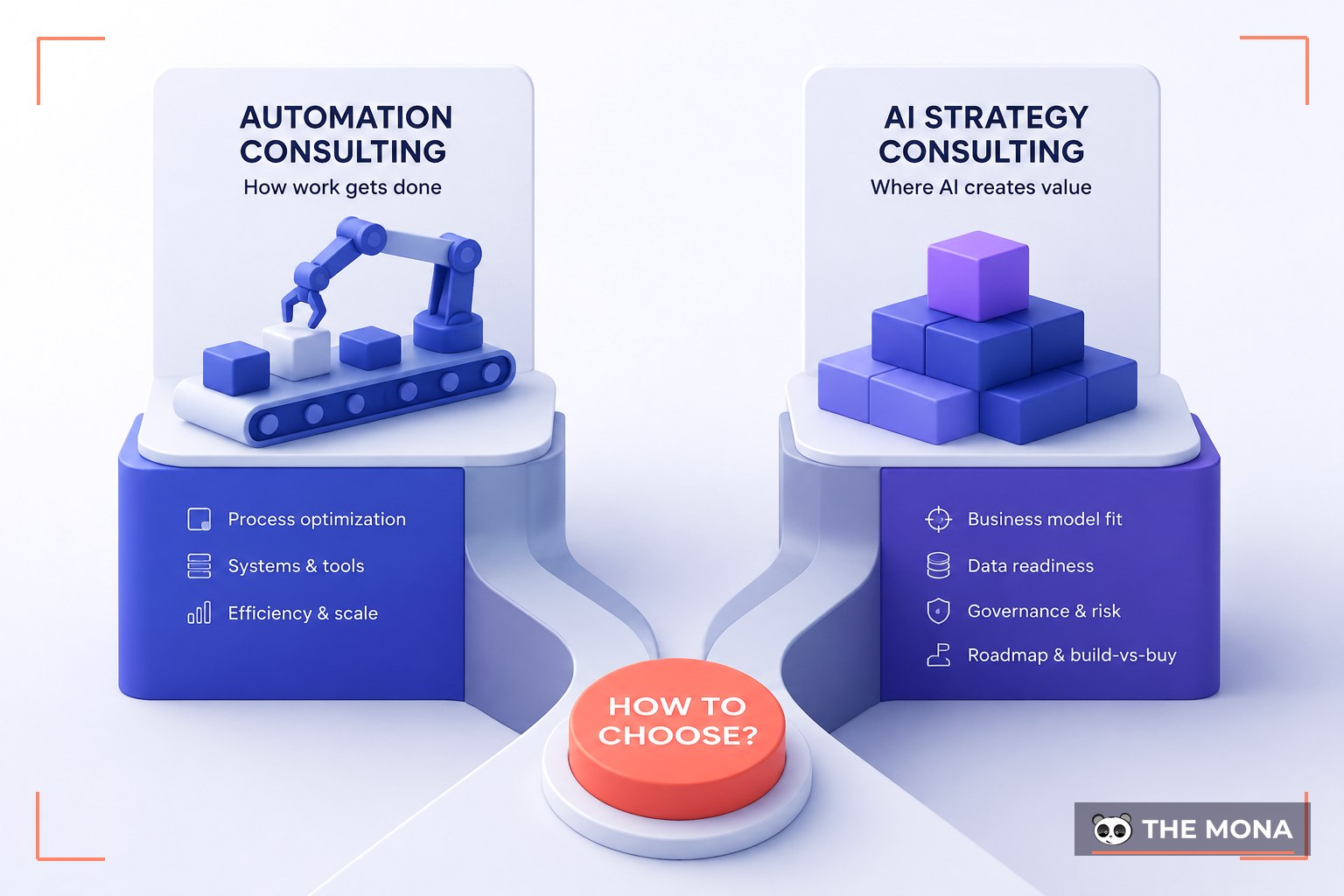
The two overlap, but they answer different questions at different altitudes:
- AI consulting works at the strategy level: where AI fits your business model, data readiness, build-vs-buy decisions, governance and risk, long-range roadmaps. The output is direction.
- Automation consulting (this page) works at the operations level: this intake process, this invoice pipeline, this reporting ritual. The output is a prioritized backlog of automations with effort estimates, tool choices, and a pilot plan you can start next month.
A useful test: if your question starts with "should we…", you probably want AI strategy consulting. If it starts with "how do we stop doing X by hand…", you want an automation consultant. Many clients do both: strategy first, then this engagement to turn direction into shipped systems. Neither requires the other.
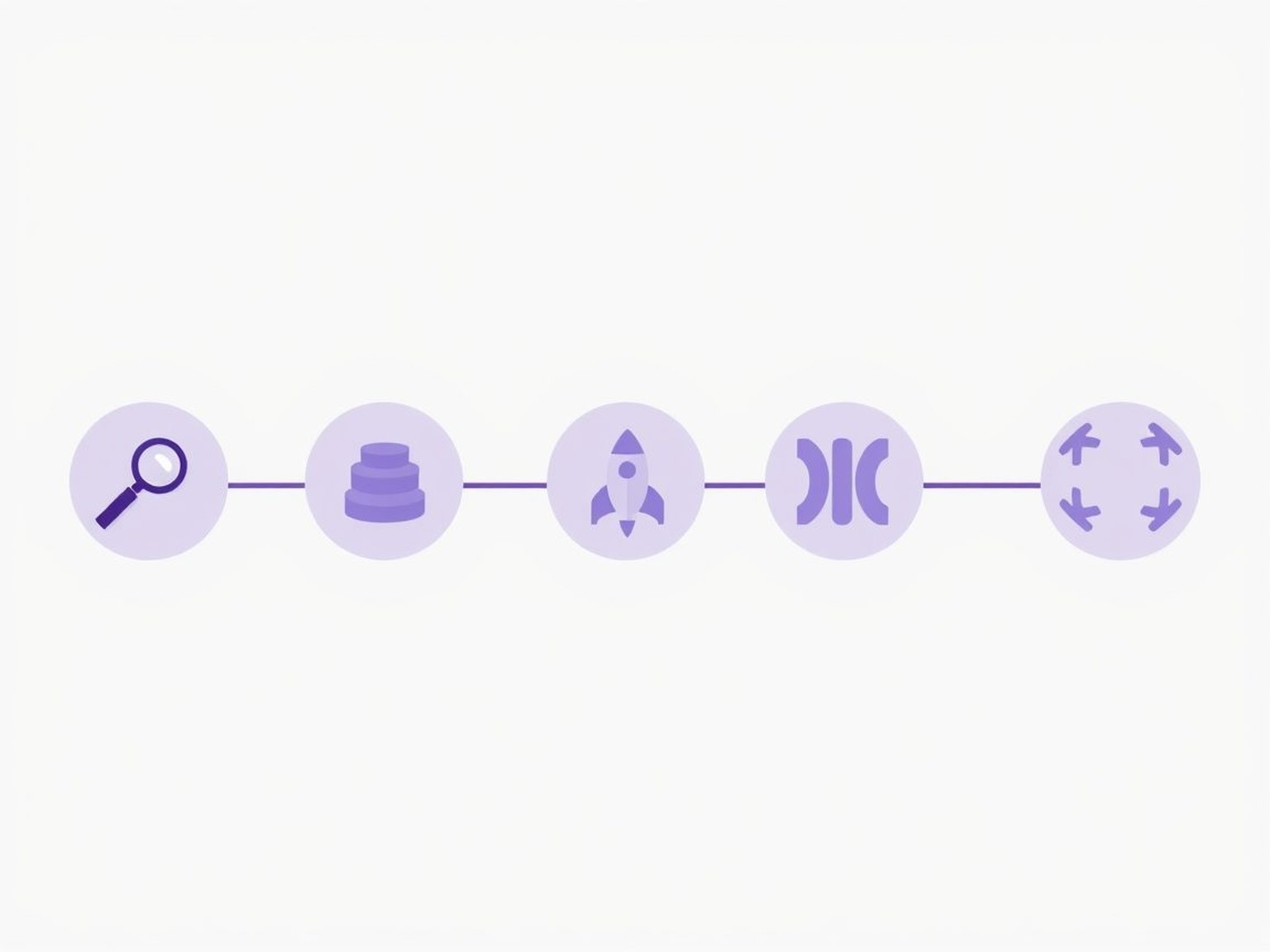
Our Automation Consulting Process: Audit → Map → Stack → Pilot → Rollout
Five stages, each with a concrete deliverable. You can stop after any stage and keep everything produced so far.
1. Process Audit: Measure the Hours You're Burning
We start with the people who actually do the work, not the org chart's version of it. Our consultants shadow workflows, walk through the tools, and quantify each process: how many times per week it runs, how many minutes per run, how many people touch it, where errors enter, and what those errors cost downstream. Vague pain ("invoicing is a mess") becomes a number ("11 hours a week across three people, with rework on roughly one invoice in ten").
Deliverable: a documented process map with time-and-cost figures per process, a baseline you'll use to judge every automation that follows.
2. Automation Opportunity Map: Ranked by ROI, Not Hype
Not everything measurable is worth automating. We score each candidate process on volume, rule-consistency, error cost, integration difficulty, and risk if the automation misfires. High-volume, rules-based, low-risk work rises to the top; edge-case-riddled, judgment-heavy work drops down or gets a human-in-the-loop design instead of full automation.
Deliverable: a prioritized opportunity map, typically a shortlist of quick wins plus a longer horizon, each with estimated hours recovered and build effort.
3. Stack Selection: No-Code vs. Custom Code vs. AI
This is where an independent-but-technical consultant earns their fee, because every vendor's answer is their own product. Ours is whatever is lightest and survives your edge cases:
- No-code / low-code (n8n, Make, native platform automations) when the process is linear, the tools have solid connectors, and volume is moderate. Fastest to ship, cheapest to change.
- Custom code (Python, Node.js, APIs, database jobs) when there's real logic, legacy systems, high volume, or no connector for what you run. Costs more upfront, doesn't hit a ceiling.
- AI components (LLM extraction, classification, drafting, agents) only where the input is genuinely unstructured: documents, emails, free-text requests. AI where rules can't reach; rules where they can, because rules are cheaper and don't hallucinate.
Most real processes end up hybrid, and because MONA builds at all three layers, we have no incentive to force one. Deliverable: an architecture recommendation per automation, with tooling, integration points, and honest trade-offs.
4. Pilot One Process: Prove It Before You Scale It
We never recommend automating ten processes at once. Pick the best candidate from the map (high ROI, contained blast radius) and take it live on a limited slice: one team, one region, one document type, with human review on outputs. We measure against the Stage-1 baseline, tune until the numbers hold under real conditions, and let your team build trust in the system before it touches anything critical.
Deliverable: one automation in production, with before/after metrics you can put in front of leadership.
5. Rollout: Scale What Worked
With a proven pilot, rollout is execution rather than a leap of faith: extend the automation across teams, work down the opportunity map in priority order, add monitoring so failures surface before your staff notices, and document everything. You own all of it: code, workflows, prompts, credentials. Companies wanting continuous expansion move to a retainer with our AI automation agency team; companies taking it in-house get handover and training instead. Both are fine; the map is yours either way.
Business Automation Services Behind the Advice
The reason our automation consulting produces different outcomes than advisory-only firms: the recommendation and the build come from the same company. MONA's business automation services cover everything the consulting stage can propose, so no recommendation dies in the gap between "the consultants" and "whoever implements it":
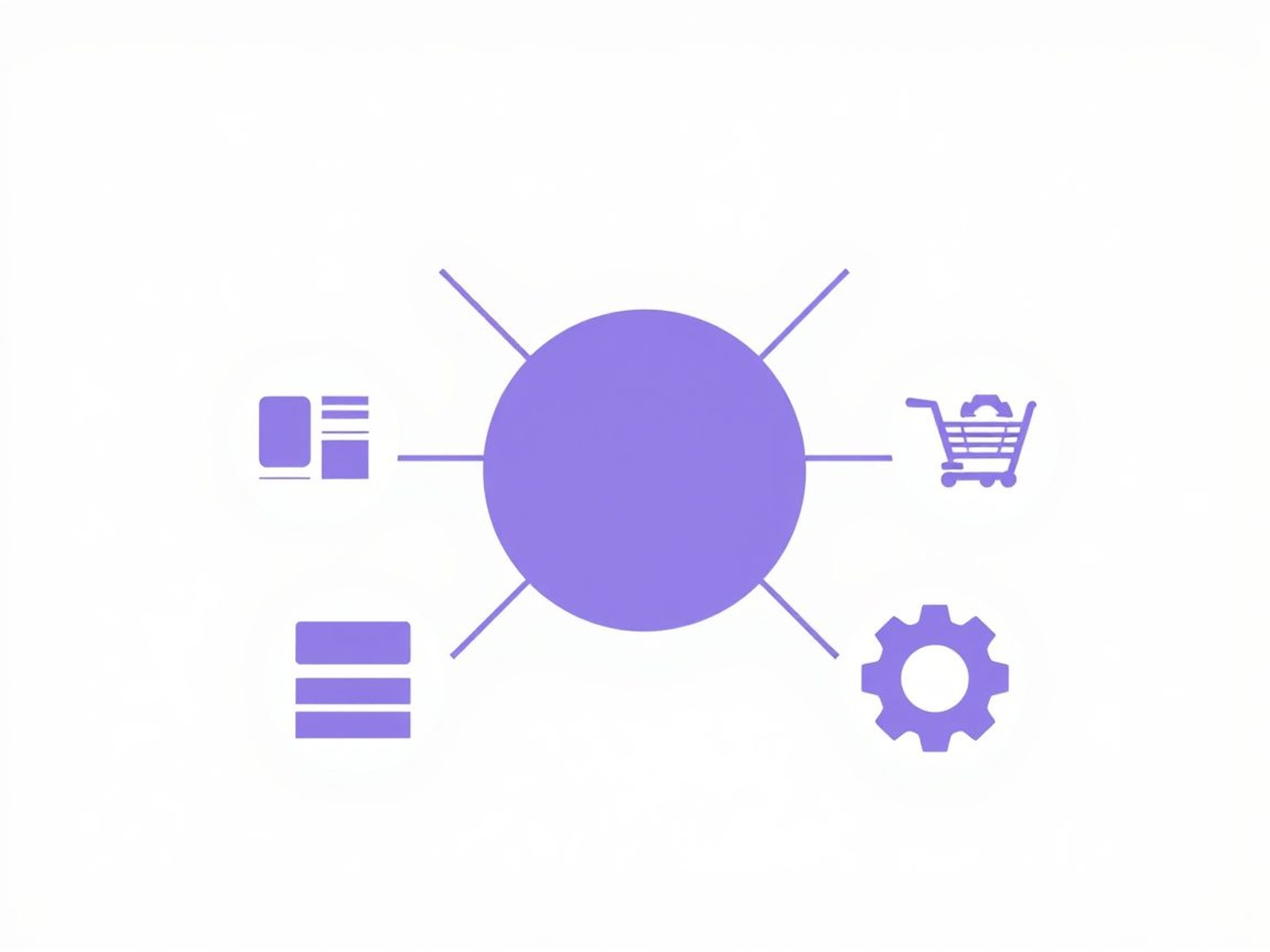
- Workflow and process automation: approval chains, data entry between systems, order processing, reconciliation, reporting packs, built out through dedicated workflow automation. For end-to-end process redesign, see our business process automation services.
- AI-powered automation: document extraction, email triage, lead qualification, drafting with human approval, and AI agents for multi-step work.
- System integration: REST APIs, webhooks, database syncs, and custom connectors that make your CRM, ERP, e-commerce platform, and internal tools behave like one system. Automation is mostly integration, and integration is what a software company behind 14,000+ delivered projects does all day.
- Custom tooling: when the honest recommendation is "no tool does this; it needs to be built," we build it rather than bending your process around someone else's product.
One accountability chain from audit to production also means the estimates in your opportunity map are real build estimates from the team that will do the building, not a consultant's guess about a contractor's future quote.
Where Business Automation Pays Off First
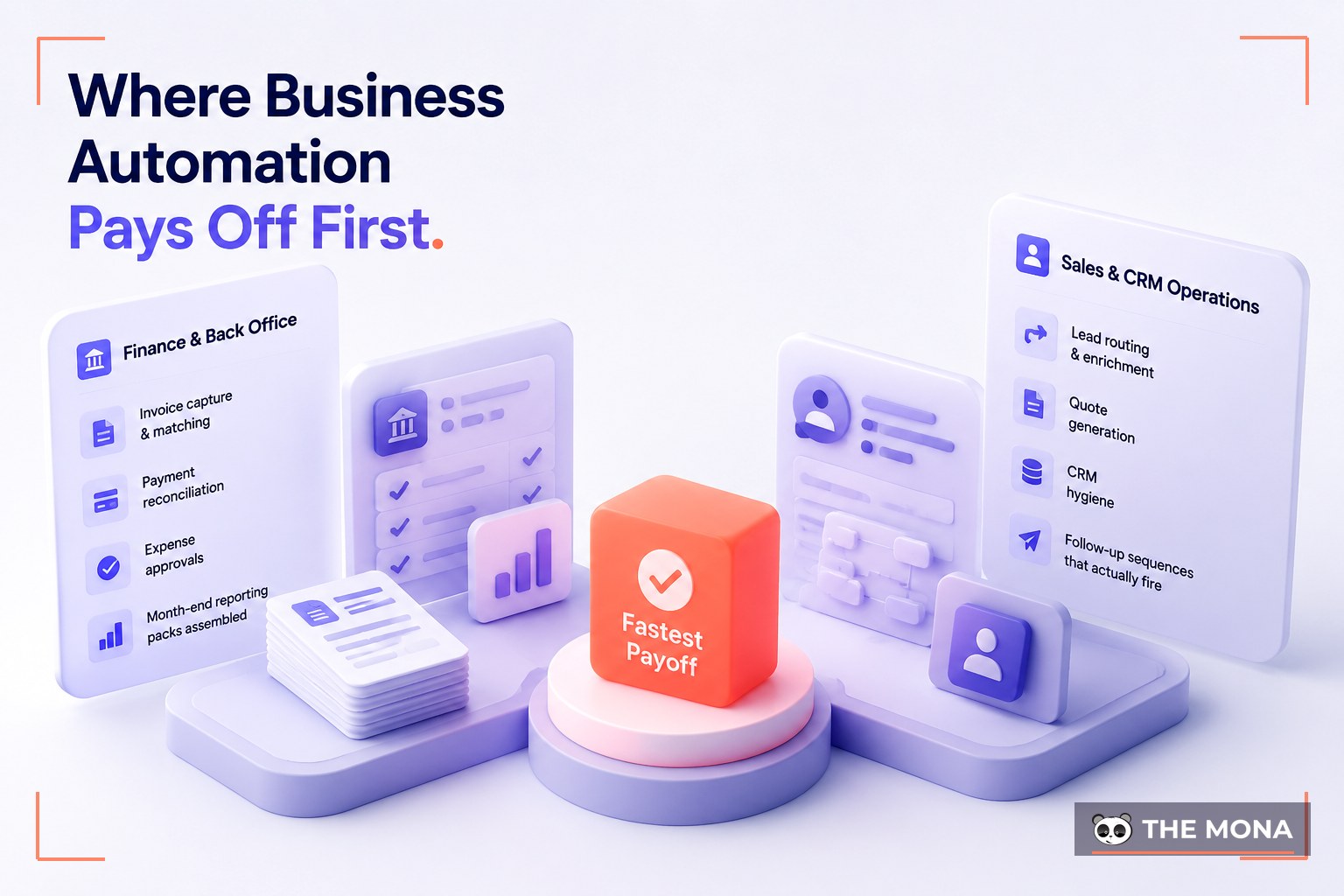
Patterns we see across 14,000+ projects delivered, wherever business automation reliably clears its cost fastest:
- Finance & back office: invoice capture and matching, payment reconciliation, expense approvals, month-end reporting packs assembled from multiple systems.
- Sales & CRM operations: lead routing and enrichment, quote generation, CRM hygiene, follow-up sequences that actually fire.
- Customer support: first-line triage, ticket classification, response drafting with human sign-off, escalation only when a person is truly needed.
- Operations & logistics: order-to-fulfillment handoffs, inventory sync across channels, shipment status updates, exception alerting.
- HR & internal admin: onboarding checklists, document collection, timesheet chasing, policy Q&A.
If your biggest cost sits in cross-system workflow orchestration itself, the dedicated workflow automation page goes deeper on that layer.
Why MONA as Your Automation Consulting Partner
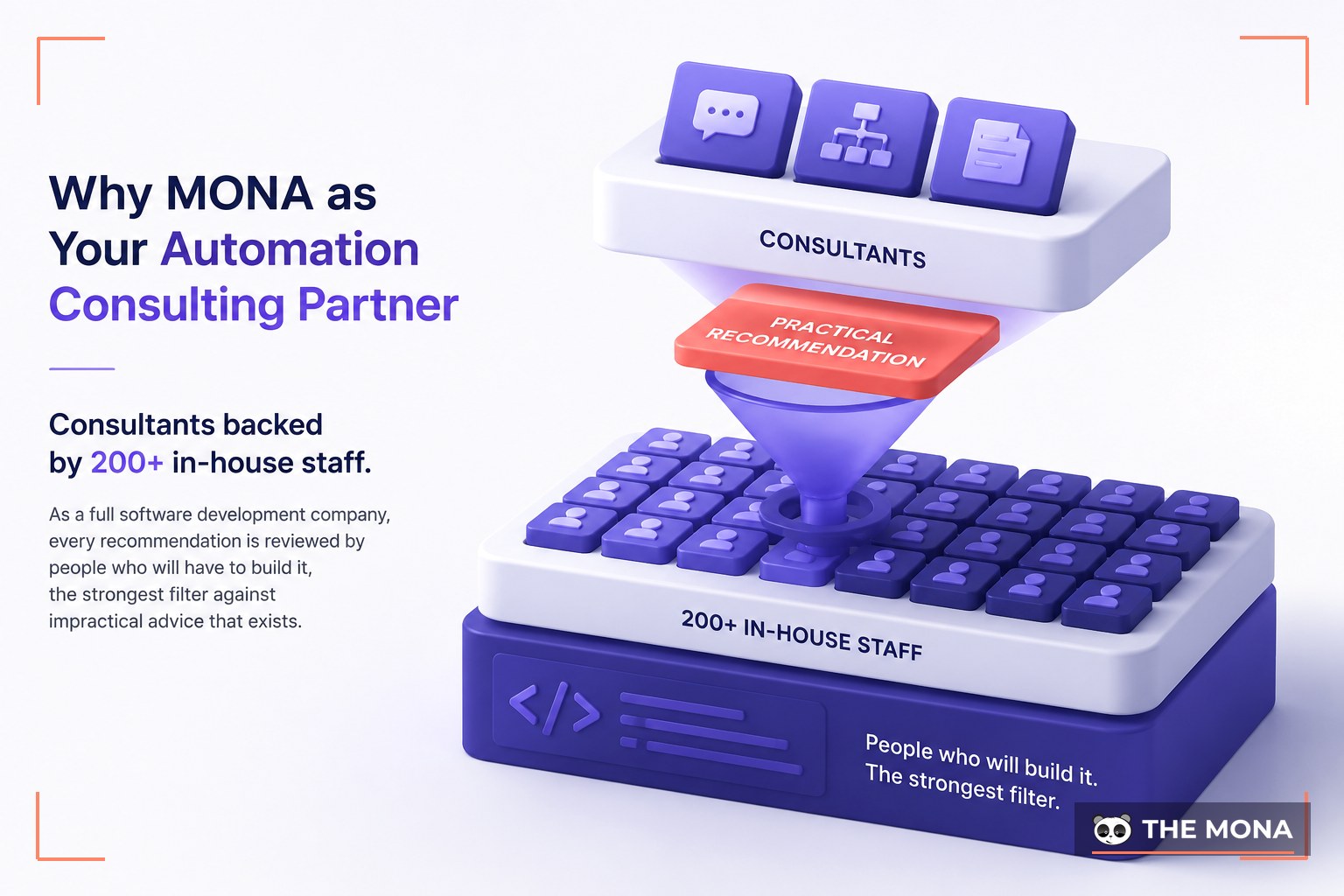
- Consultants backed by an in-house engineering team. As a full software development company, every recommendation is reviewed by people who will have to build it, the strongest filter against impractical advice that exists.
- 10+ years of software delivery, 14,000+ projects delivered. We've built the CRMs and ERPs on the other side of your APIs, so we know what integrations actually cost before we put a number in your roadmap.
- Vietnam economics, global delivery. Consulting and engineering from Vietnam cost a fraction of US or Western European rates, which changes strategy: you can afford to pilot, tune, and iterate instead of betting everything on one big launch. GMT+7 overlaps European mornings and US evenings.
- Tool-neutral by structure. We build in no-code, custom code, and AI, so we don't need to steer you toward any of them.
- You own everything. Process maps, opportunity maps, architecture docs, code, workflows, credentials. No proprietary platform, no ransom.
Engagement Models
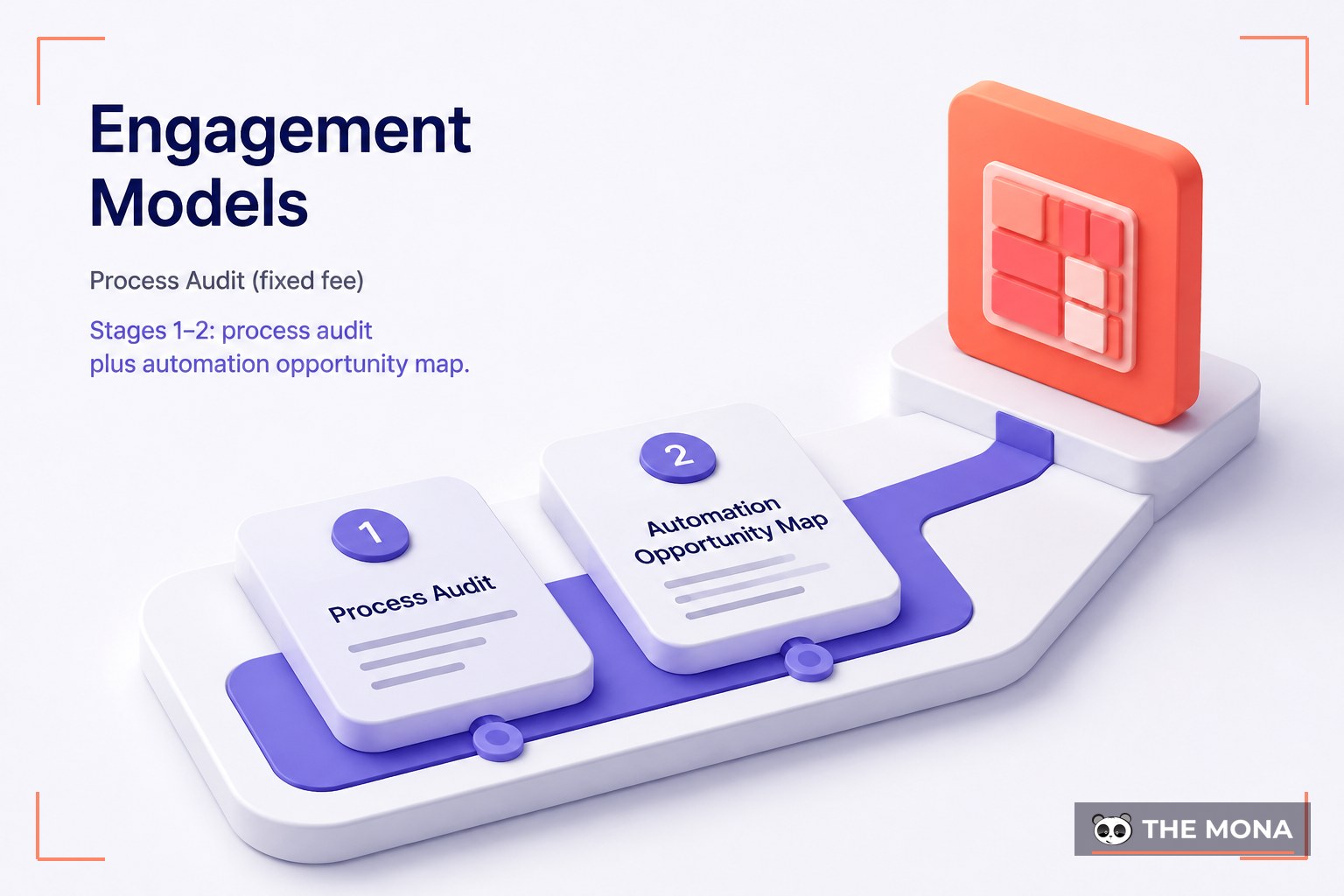
- Process Audit (fixed fee). Stages 1-2: process audit plus automation opportunity map. The most common starting point, and fully usable on its own, with us or with another builder.
- Audit + Pilot. Stages 1-4: everything above, plus one automation designed, built, and proven in production against a measured baseline.
- Full Program. Audit through rollout, working down the opportunity map with monitoring and support.
- Ongoing Automation Retainer. Continuous consulting and building as your processes evolve: effectively the automation function you don't have to hire, run with our AI automation agency team.
Every engagement starts with a free consultation and a clear scope before any commitment.
Ready to Stop Guessing What to Automate?
Bring us the process that's costing you the most hours. We'll audit it, map the ROI, and show you exactly what we'd build first, before you commit to anything.