


MONA designs and builds business process automation solutions for finance, HR, sales operations, and procurement, standardizing the process first, then automating it with software our in-house engineers build and maintain.
What Business Process Automation Means

Business process automation (BPA) is the use of software to execute recurring business processes (approvals, data transfers, document handling, reporting) with minimal human intervention. Instead of people moving information between systems by hand, the process itself is defined as rules and logic, and software carries it out the same way every time.
That's the textbook answer. Here's the practical one: BPA is what you do when your company runs on processes that live in people's heads, inboxes, and spreadsheets, and every month of growth makes them slower, more error-prone, and harder to hand over.
It helps to place BPA next to its neighbors:
- Workflow automation automates a single sequence of tasks: one approval chain, one notification flow. BPA operates a level up: it automates an entire business process end to end, often spanning several workflows, departments, and systems.
- RPA (robotic process automation) uses software bots that mimic human clicks and keystrokes in existing interfaces, useful when a legacy system has no API. BPA is broader: it redesigns the process and connects systems directly, using RPA as one tool among several where it fits.
- AI automation adds models that read, classify, and decide inside a process, such as extracting data from an invoice or triaging a request. In mature BPA projects, AI handles the judgment steps and rules handle the rest.
If you're comparing these approaches for a specific process, the free audit below is the fastest way to get a straight answer on which one you actually need.
Business Process Automation Services We Deliver
Most BPA failures share one root cause: automating a process that was never standardized. If three account managers each have their own way of raising a quote, automating "the" process just hardens one person's habits into software. So our business process automation services always run in the same order: standardize, then automate, then maintain.
Process Discovery & Standardization
We map how the process actually runs, with the people who run it, not just the org chart version. We document variants, exceptions, and handoffs, then work with your team to agree on one standard process worth automating. Output: a documented process map, a baseline of hours currently spent, and a ranked automation shortlist.
Process Automation Design & Build
For each process we define triggers, business rules, system integrations, human approval checkpoints, and the success metric, before writing code. Then our engineers build it: forms, logic, integrations, notifications, dashboards. You approve the design first, and you own everything we ship.
System Integration
Departmental processes almost always cross systems: CRM to accounting, HRIS to payroll, e-procurement to ERP. We build the connectors (APIs, webhooks, database syncs, legacy bridges) so data entered once flows everywhere it's needed. This is where a decade of building CRM, ERP, sales, and HR systems pays off: we usually know what's on the other side of the API because we've built that side.
Monitoring, Support & Continuous Improvement
Processes change (new products, new policies, new team structures), and automations that nobody maintains fail silently. We monitor every run, alert on exceptions before your team notices them, and adapt the automation as the business evolves.
Processes We Automate, Department by Department
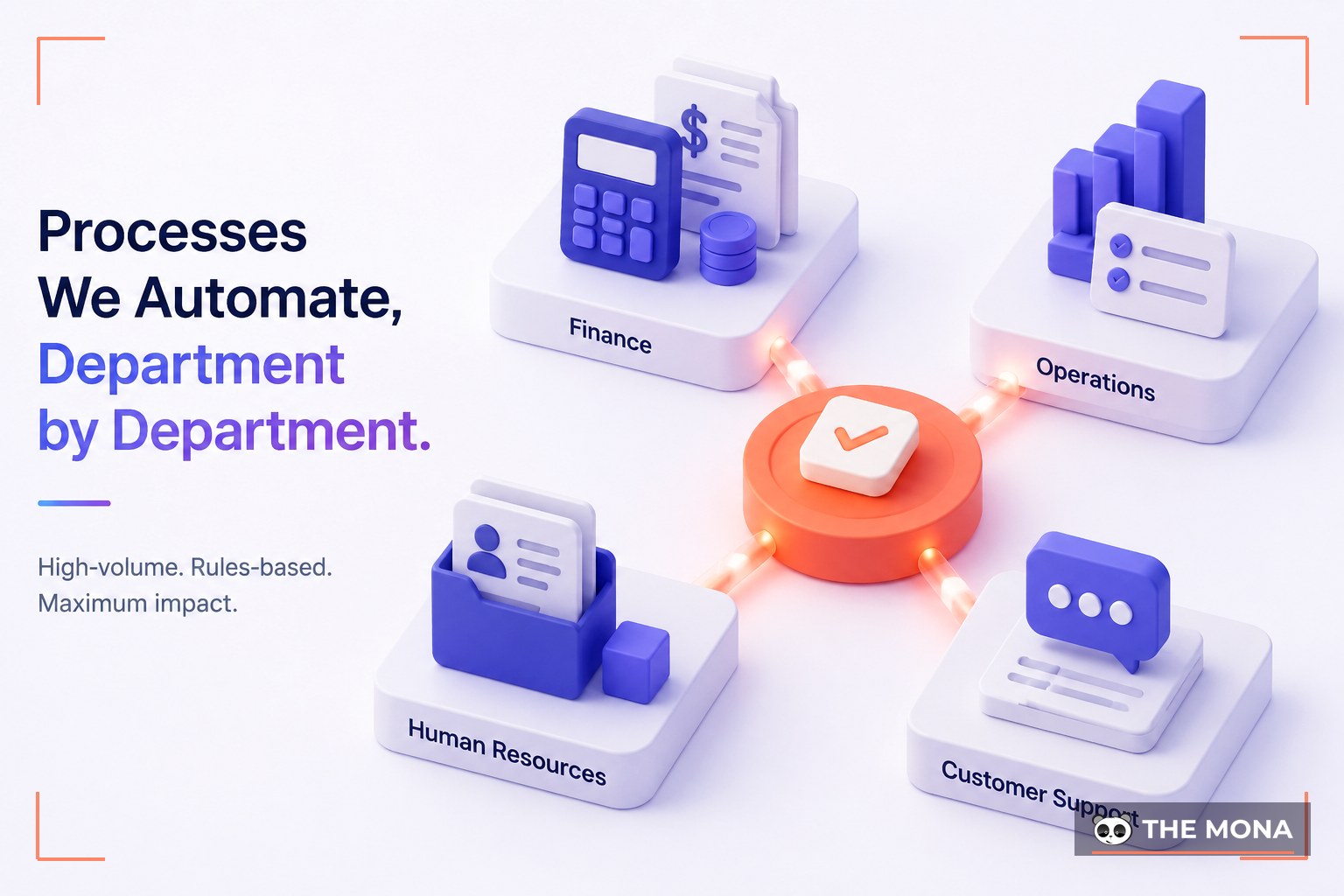
BPA delivers the fastest returns in departments that run on high-volume, rules-based work. These are the four we're asked about most.
Finance & Accounting
Invoice capture and approval routing, payment reconciliation, expense claim processing, recurring billing, debt-chasing sequences, month-end reporting packs. Finance processes are ideal first candidates: high volume, clear rules, and error costs that make the ROI case by themselves.
Human Resources
Employee onboarding and offboarding checklists that actually execute themselves: accounts created, equipment requested, training assigned, access revoked on exit. Plus leave requests, timesheet consolidation, CV screening pipelines, and contract renewals that never get forgotten.
Sales Operations
Lead routing and assignment rules, quote and proposal generation from CRM data, order-to-invoice handoffs, pipeline hygiene, commission calculations, and the weekly sales reports someone currently assembles by hand. If your CRM is the bottleneck rather than the process, our CRM development company team builds and customizes the system itself.
Procurement & Supply Chain
Purchase request and approval chains with spend-based routing, supplier onboarding, PO matching (order-receipt-invoice), inventory reorder triggers, and delivery exception alerts. Procurement is where approval bottlenecks hide: a two-day wait on a signature repeated hundreds of times a year is a full-time employee's worth of lost throughput.
Cross-department processes, such as document generation and e-signing, management reporting, and data synchronization between systems, round out most engagements.
Custom BPA Software vs Off-the-Shelf Tools
There are hundreds of business process automation tools on the market, and for simple, standard processes they're often enough. We'll tell you when that's the case; it's a shorter project for us and a better outcome for you.
But off-the-shelf business process automation software has a ceiling, and growing companies hit it predictably:
- Your process doesn't fit the template. Tools model generic approval flows; your reality has regional rules, currency quirks, exception paths, and a legacy system in the middle.
- Per-user pricing punishes adoption. The more of your company uses the automation, the more you pay, the opposite of how ROI should work.
- Your data lives in the vendor's box. Reporting, audits, and integrations all bend around someone else's schema.
That's why MONA builds custom BPA software when the process justifies it: automation applications shaped exactly to your process, integrated with your existing systems, running on infrastructure you control, with no per-seat meter. Because we've built management software (CRM, ERP, sales, and HR systems) for over a decade, custom BPA isn't an exotic project for us; it's the same discipline applied to your operations.
Our working rule: the lightest tool that survives your edge cases. Off-the-shelf where it fits, custom where it doesn't, and an honest recommendation either way.
How We Measure ROI: Hours Saved, Not Features Shipped
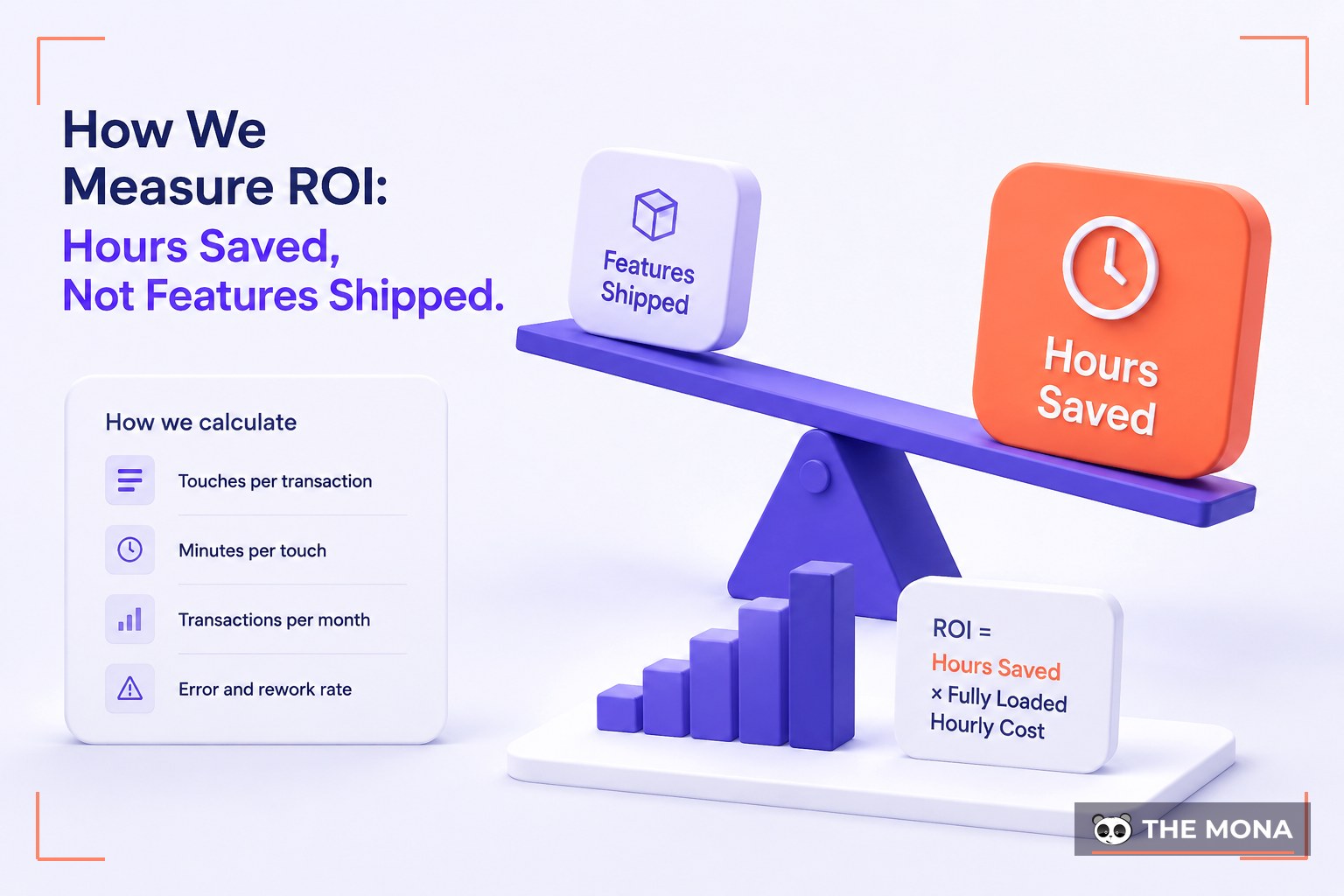
Every automation we propose comes with a simple arithmetic you can check:
- Baseline the process. During discovery we measure how the process runs today: touches per transaction, minutes per touch, transactions per month, error and rework rate.
- Project the savings. Design defines exactly which steps go automatic and which keep a human checkpoint, so the hours-saved estimate comes from the process map, not from a brochure.
- Measure after go-live. The automation logs every run, so "hours saved per month" is a dashboard number, not a feeling. If the number disappoints, we tune the process; that's part of the engagement, not a change request.
Time saved is the primary metric because it's the honest one: it converts directly to payroll cost, capacity, and how fast your team can grow revenue without growing headcount. Error reduction, cycle-time cuts, and audit readiness come with it, but hours are where we make the promise.
Why Companies Choose MONA for Business Process Automation
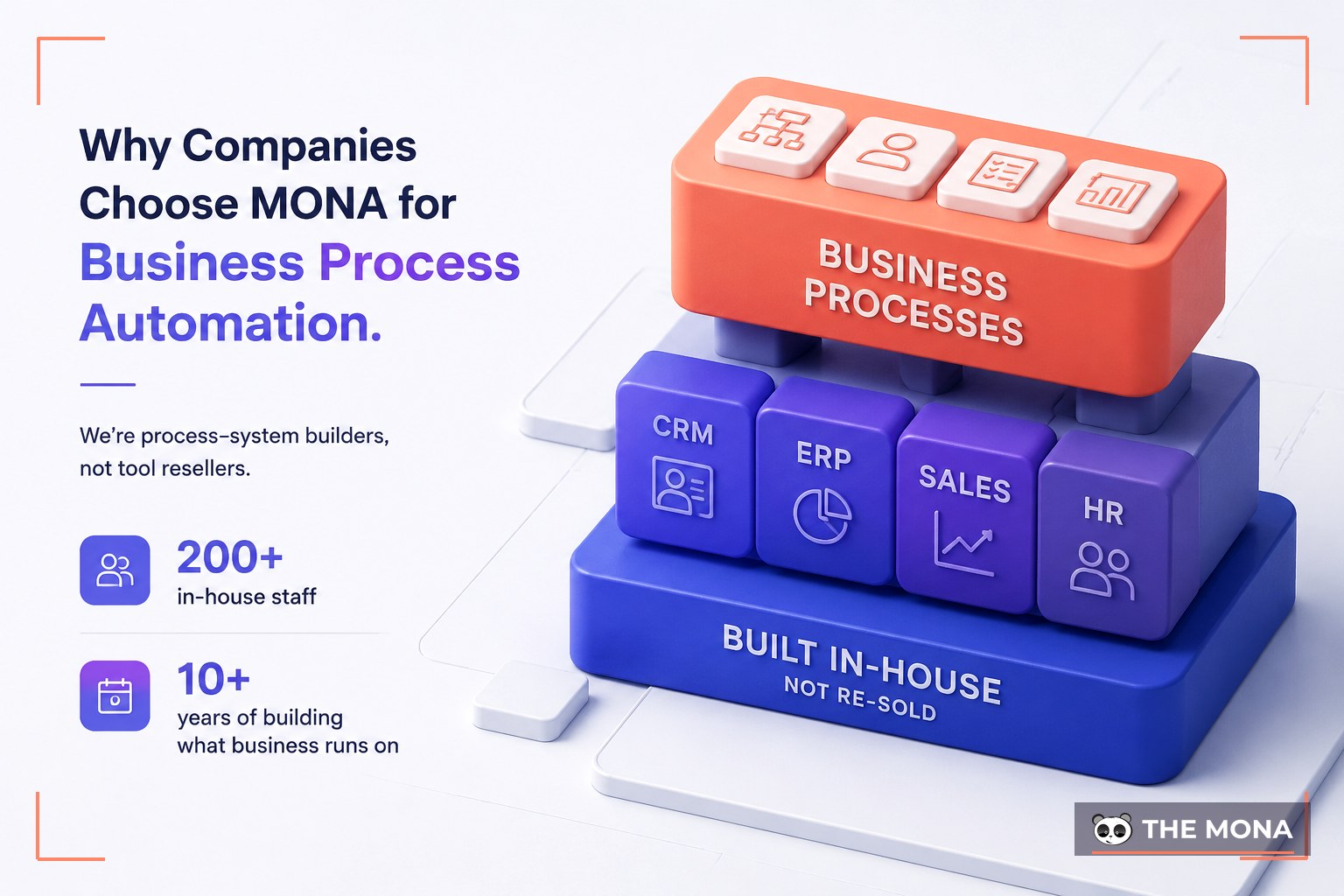
- We're process-system builders, not tool resellers. Our in-house engineers have spent 10+ years building the CRM, ERP, sales, and HR systems that business processes actually run on. We automate systems we understand from the inside.
- 14,000+ projects delivered. From e-commerce operators to professional services firms, we've seen how back offices really work, including the undocumented exceptions that break naive automation.
- Engineering economics that favor iteration. BPA succeeds through pilot-tune-expand cycles. With Vietnam-based engineering rates, you can afford to iterate instead of betting everything on one big-bang rollout, and our GMT+7 time zone overlaps European mornings and US evenings for daily communication.
- You own the result. Code, workflows, documentation, and credentials are yours. No proprietary platform holding your processes hostage.
- One partner across the stack. When an automation needs a custom API, a database, an integration, or hosting, we build and run it in-house rather than declaring it out of scope.
If your priority is applying AI across operations end to end (agents, chatbots, document intelligence), our AI automation agency engagement is the broader offer; this page's BPA services plug into it as the process backbone.
What a BPA Engagement Looks Like
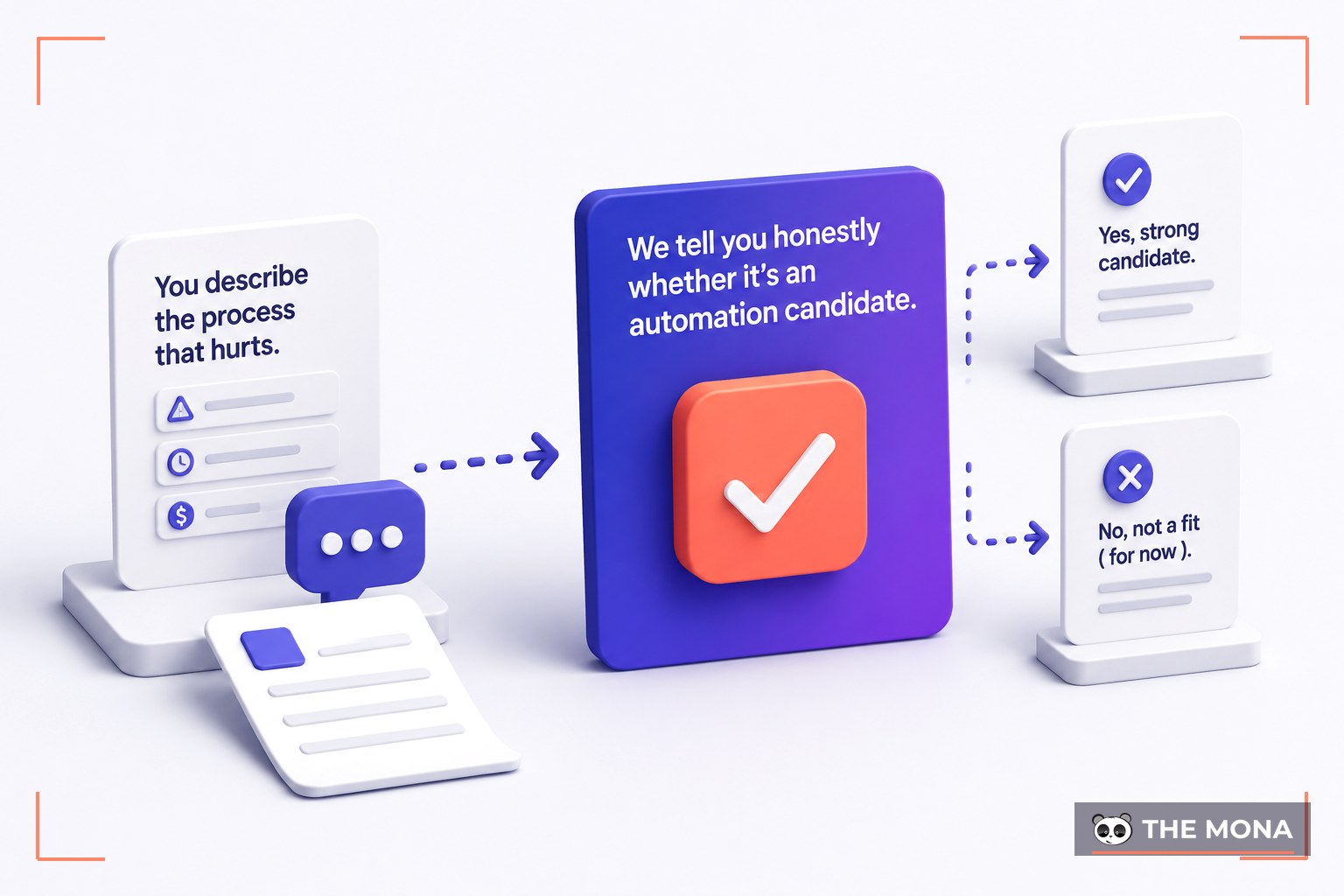
- Free consultation. You describe the process that hurts; we tell you honestly whether it's an automation candidate.
- Process audit (fixed fee). Discovery, mapping, baseline measurement, and a ranked automation roadmap with projected hours saved per process.
- Pilot build. We automate the highest-ROI process first, on a limited scope, with human checkpoints, and prove the savings number.
- Expand. With the pilot's measured ROI as the template, we roll through the roadmap, department by department.
- Operate & improve. Ongoing monitoring and adaptation, either as a support retainer or with your team fully trained to own it.
Book a free process audit: bring your most painful process, leave with a map of what it costs you per month and what automating it would save.
Ready to See What Your Process Is Costing You?
Bring us the process that runs on spreadsheets and inboxes. We'll baseline the hours it costs, map what automating it would save, and tell you honestly whether it's worth building.