


An offshore development center gives you a dedicated, long-term software team that works as an extension of your company, at a fraction of Western hiring costs. This guide explains how the ODC model works, what it really costs, and exactly how to launch one in Vietnam, whether you do it yourself or with a partner like MONA.
What an Offshore Development Center Is

An offshore development center (ODC) is a dedicated software engineering team based in another country (typically one with lower operating costs and a deep talent pool) that works exclusively for your company on a long-term basis.
Unlike a one-off outsourcing contract, an ODC is not built around a single project with a fixed scope and end date. It is a standing team: your developers, QA engineers, designers, and project managers, working on your product roadmap, in your tools, under your direction. The ODC provider (or your own local legal entity) handles the physical and administrative layer (recruitment, payroll, office space, equipment, HR compliance) while you own the technical direction and the output.
Think of it as the middle ground between hiring freelancers and opening a foreign subsidiary:
- More control than outsourcing. The team works only on your product, follows your processes, and accumulates deep knowledge of your codebase over years, not months.
- Less overhead than a subsidiary. You skip company registration, local labor law administration, and office leases, or defer them until the team is large enough to justify them.
Companies typically build an ODC when they need to scale engineering capacity fast, when local hiring is too slow or too expensive, or when they want a permanent second engineering hub rather than a temporary vendor relationship.
ODC vs. Outsourcing vs. Staff Augmentation
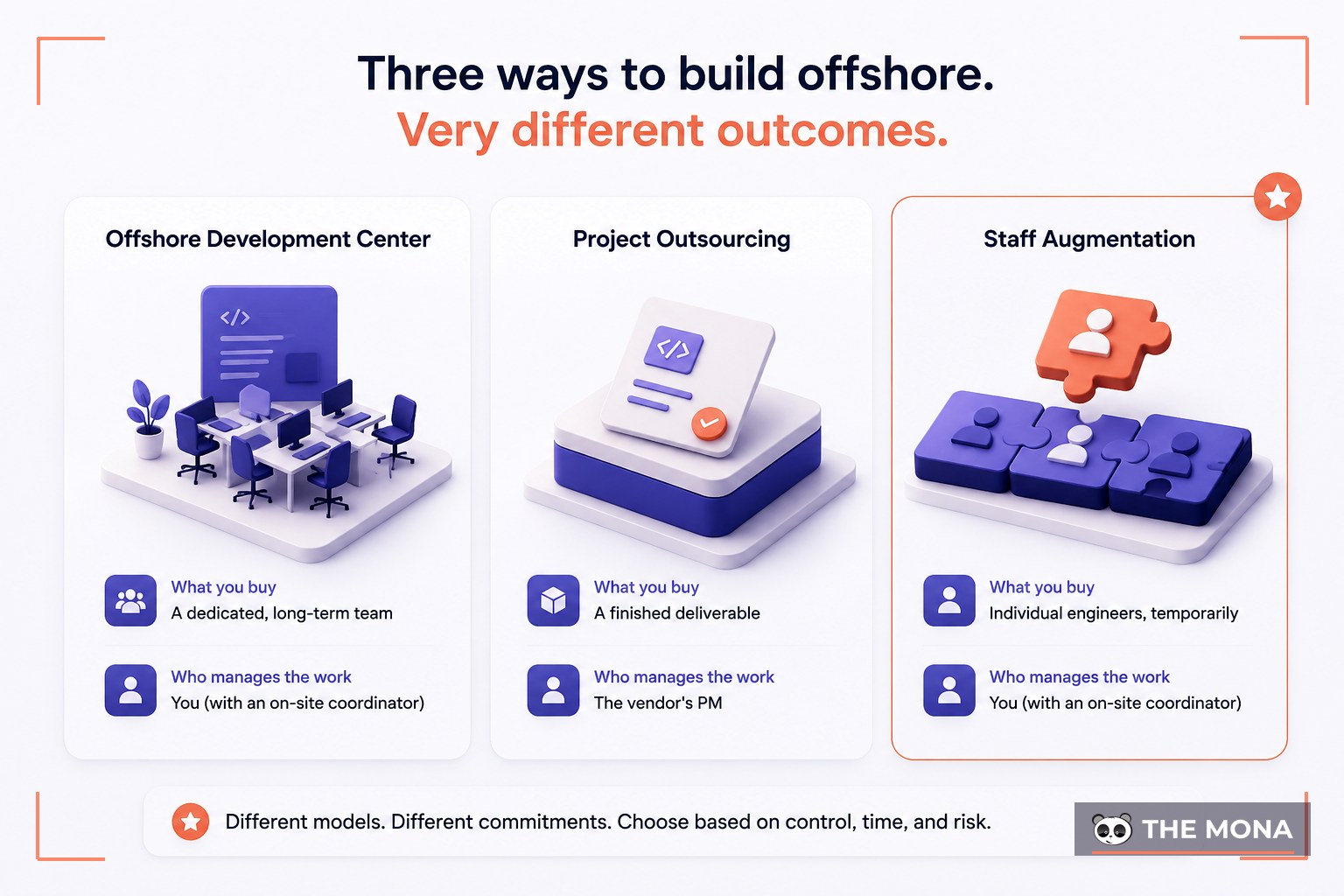
These three models are often confused, and choosing the wrong one is the most common (and most expensive) mistake companies make when going offshore. Here is how they actually differ:
| Offshore Development Center | Project Outsourcing | Staff Augmentation | |
|---|---|---|---|
| What you buy | A dedicated, long-term team | A finished deliverable | Individual engineers, temporarily |
| Who manages the work | You (with an on-site coordinator) | The vendor's PM | You, fully |
| Duration | Years, ongoing | Weeks to months, per project | Months, per contract |
| Team continuity | High: same people, growing product knowledge | Low: team may change between projects | Medium: individuals may rotate |
| IP and code ownership | Yours, contractually and operationally | Yours, but knowledge stays with vendor | Yours |
| Cost model | Monthly per-seat or cost-plus | Fixed price or time & materials | Hourly/monthly rate per person |
| Best for | Product companies scaling engineering long-term | Well-defined, bounded projects | Filling short-term skill gaps |
The short version:
- Choose project outsourcing when you have a clearly scoped build (a website, an app, a migration) and you want someone else to deliver it end to end.
- Choose staff augmentation when your existing team just needs two or three extra engineers for six months.
- Choose an ODC when software is core to your business and you need a durable engineering capability, not a one-time delivery.
Many companies actually start with outsourcing or a dedicated development team on a single project, validate the working relationship, and then convert it into a full ODC. That staged approach de-risks the decision considerably, and it is how most of MONA's long-term international engagements have started.
Inside an Offshore Development Center: Team Structure and Roles

A functioning offshore development team is more than a group of developers on a payroll. A typical ODC includes:
- Software engineers: the core of the team, usually a mix of senior and mid-level developers matched to your stack (web, mobile, backend, or full-stack).
- QA engineers: manual and automated testing, embedded in the team rather than bolted on at the end.
- A team lead or tech lead: your primary technical counterpart, responsible for code quality and day-to-day technical decisions.
- A project manager or delivery manager: coordinates sprints, reporting, and communication across time zones; often the single most important role for making offshore work feel local.
- Optional roles as you scale: UI/UX designers, DevOps engineers, business analysts, data engineers.
On the provider side, the ODC operator supplies the invisible layer: recruiters who know the local market, HR and payroll administration, legal compliance, office space, hardware, IT security, and employee retention programs. When this layer works well, you barely notice it exists, which is exactly the point.
Governance matters more than geography. Successful ODCs run on the client's process: your Git workflow, your ticketing system, your definition of done, your sprint cadence. The teams that fail are almost always the ones treated as an external vendor to "send requirements to," rather than as colleagues in another office.
Why Vietnam Is a Leading ODC Destination
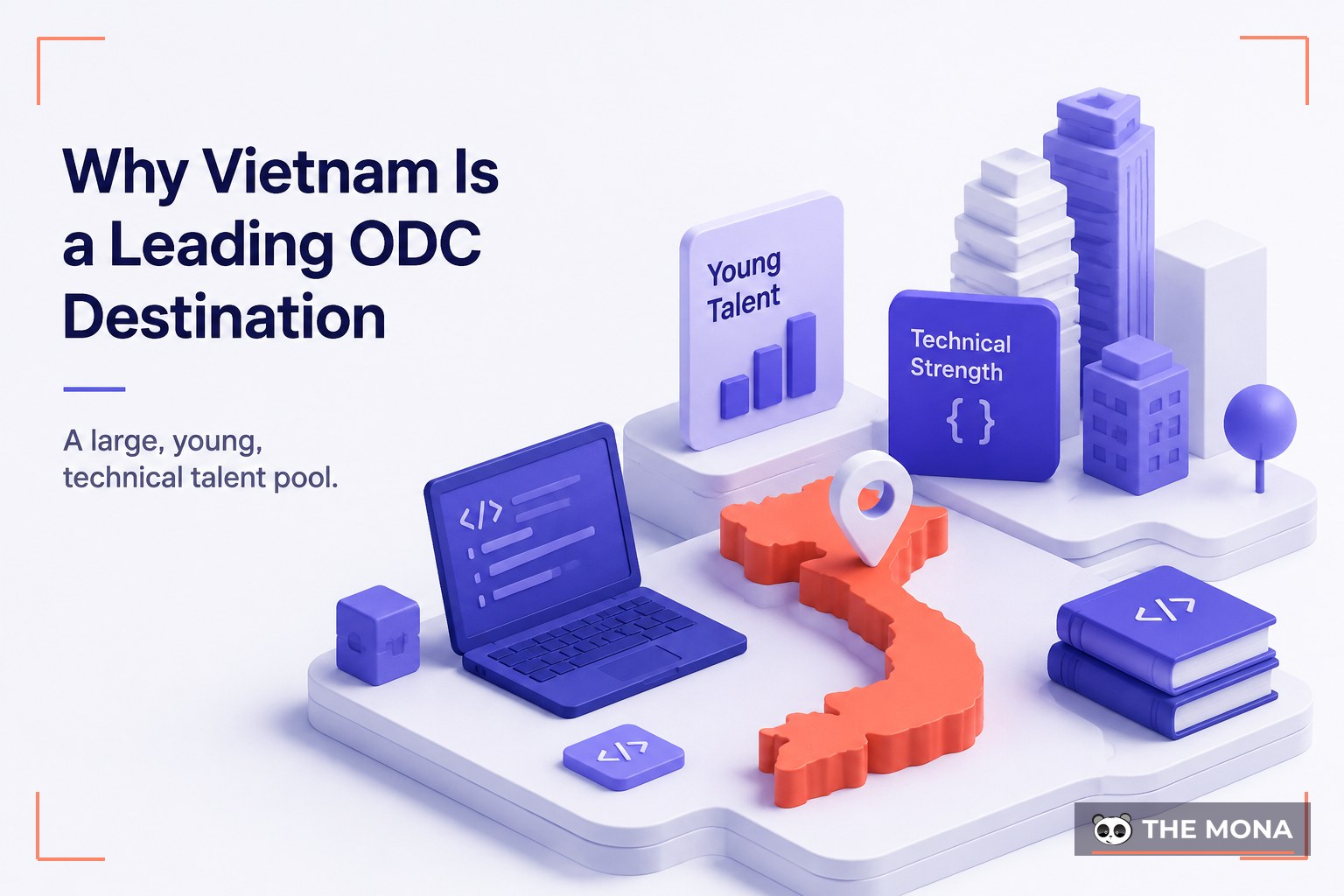
Vietnam has spent the past decade becoming one of Asia's strongest software engineering hubs, and it is now a default shortlist entry for companies setting up an ODC. The reasons are practical:
A large, young, technical talent pool. Vietnam graduates tens of thousands of IT and engineering students every year, and its developer community is strong in exactly the areas modern product companies need: web platforms, mobile, e-commerce, cloud, and increasingly AI and data engineering.
Significant cost advantage. Total engineering costs in Vietnam are significantly lower than US, Western European, or Singaporean rates, typically also below more established offshore markets like Poland, and competitive with India, while quality at the senior level is comparable.
Proven delivery to demanding markets. Vietnamese teams have a long track record serving Japanese, Korean, Australian, European, and North American clients. These are markets known for exacting quality and process standards. MONA's own international client base includes these high-standards markets.
Time zone leverage. GMT+7 overlaps comfortably with Australia and most of Asia during business hours, and gives European and US teams a "follow-the-sun" rhythm: work handed off in the evening is progressing while you sleep.
Stability and infrastructure. Major hubs (Ho Chi Minh City, Hanoi, Da Nang) offer reliable power and internet, modern office stock, and a government actively courting the IT sector.
English proficiency. Working English is standard across the professional developer population, and client-facing roles (PMs, leads, BAs) are routinely fluent.
What an Offshore Development Center Costs

ODC pricing has two honest components, and any provider quoting you a single suspiciously low number is hiding one of them.
1. Direct team cost. Salaries for your engineers, QA, and management, plus mandatory employer contributions (social insurance, health insurance) and standard benefits. This is the largest component and scales linearly with headcount and seniority mix.
2. Operating and management cost. Office space, equipment, software licenses, recruitment, HR administration, IT security, and the provider's management fee. In a managed ODC, this is usually bundled into a per-seat monthly rate or a transparent "cost-plus" model.
The pricing models you will encounter:
- Per-seat monthly rate: one flat price per team member, all-inclusive. Simple to budget, less transparent about underlying salaries.
- Cost-plus: you see real salaries and pay a disclosed margin on top. More transparent, preferred for larger or longer engagements.
- Build-Operate-Transfer (BOT): the provider builds and runs the center for a fixed period, then transfers the entire operation (staff, assets, sometimes the legal entity) to you.
As a rule of thumb, an ODC only becomes clearly more economical than plain outsourcing at around five or more people retained for a year or more. Below that, a dedicated team or project engagement is usually the better buy.
How to Set Up an Offshore Development Center in Vietnam
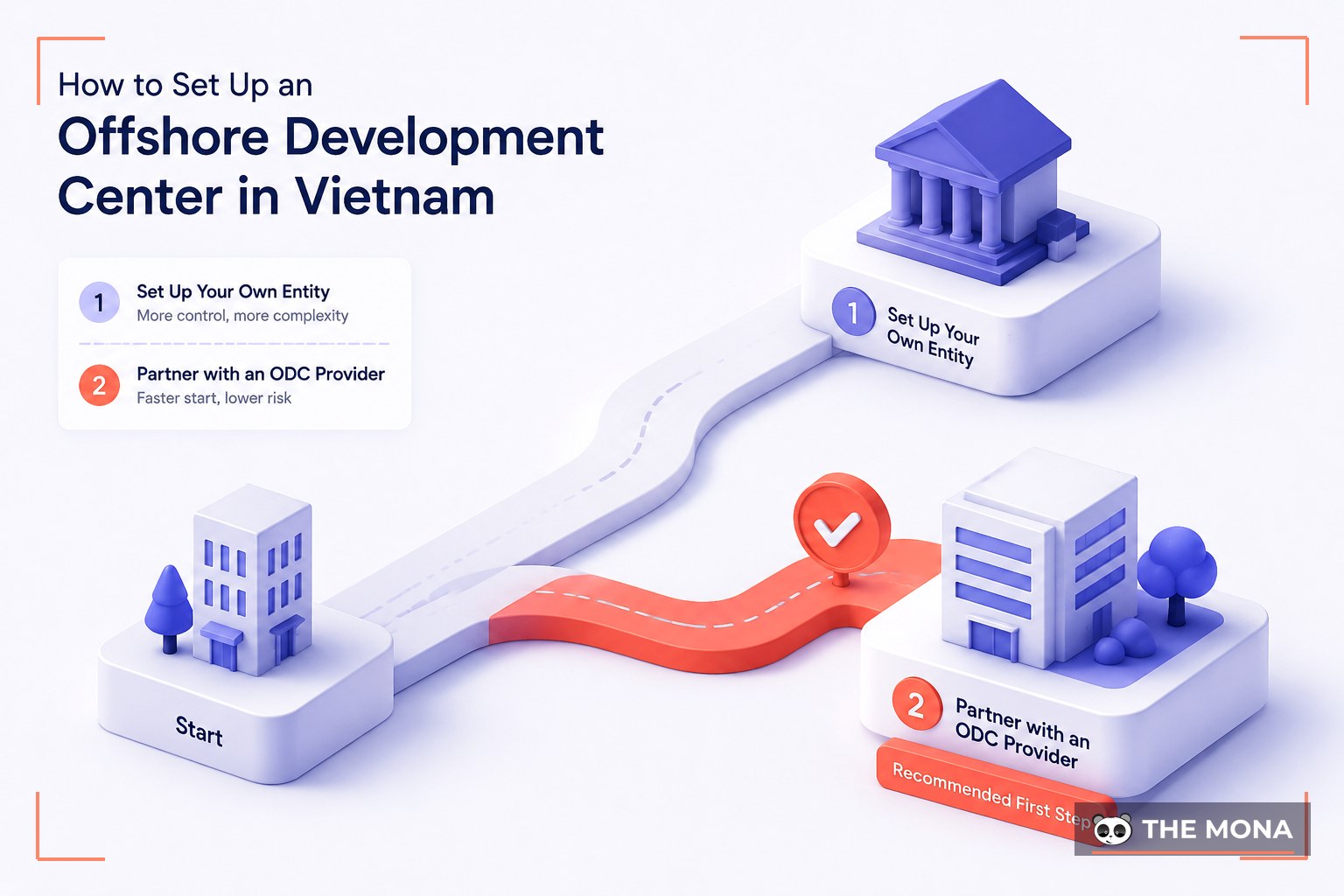
There are two routes. Most companies should take the second one first.
Option A: Set Up Your Own Legal Entity
The do-it-yourself route means establishing a foreign-invested company in Vietnam (typically a 100% foreign-owned LLC) and hiring your team directly:
- Choose your structure and location. An LLC is the standard vehicle; Ho Chi Minh City, Hanoi, and Da Nang are the main talent hubs.
- Obtain your Investment Registration Certificate (IRC): approval of your foreign investment project.
- Obtain your Enterprise Registration Certificate (ERC): the company's incorporation document.
- Complete post-licensing setup: company seal, tax registration, bank accounts, charter capital contribution, social insurance registration.
- Lease an office and hire. Recruit through local job platforms and agencies; register employees for social and health insurance; comply with Vietnamese labor law.
Realistically, incorporation alone takes a few months once documents are in order, and getting from decision to a productive first team commonly takes six months to a year.
Option B: Launch Through an ODC Partner (Managed ODC or BOT)
The faster route: partner with an established Vietnamese company that already has the legal entity, offices, recruiters, and HR machinery. You define the roles; they hire and host your team; you direct the work from day one.
- Define the team. Roles, seniority, stack, and the first quarter's roadmap. A good partner will challenge and refine this with you.
- Sign the framework agreement. This must cover IP assignment, confidentiality, data security standards, replacement guarantees, and exit terms, including your right to take the team in-house later.
- Recruit. The partner sources candidates; you interview and approve every hire.
- Onboard onto your systems. Your repositories, your CI/CD, your Slack/Jira, your security policies. Treat week one exactly like onboarding a local hire.
- Establish the operating rhythm. Sprint cadence, demo schedule, escalation paths, and a named delivery manager on the Vietnam side who owns communication.
- Scale deliberately. Start with a core of three to five, stabilize velocity, then grow.
Typical timeline with a partner: first developers productive in one to two months, a stable full team within three to six. Compare that with six to twelve months for the entity route.
This is the model MONA operates for international clients: we run the Vietnam side (recruitment, employment, workspace, HR, retention) while your team reports to you.
When an ODC Is the Right Call (and When It Isn't)
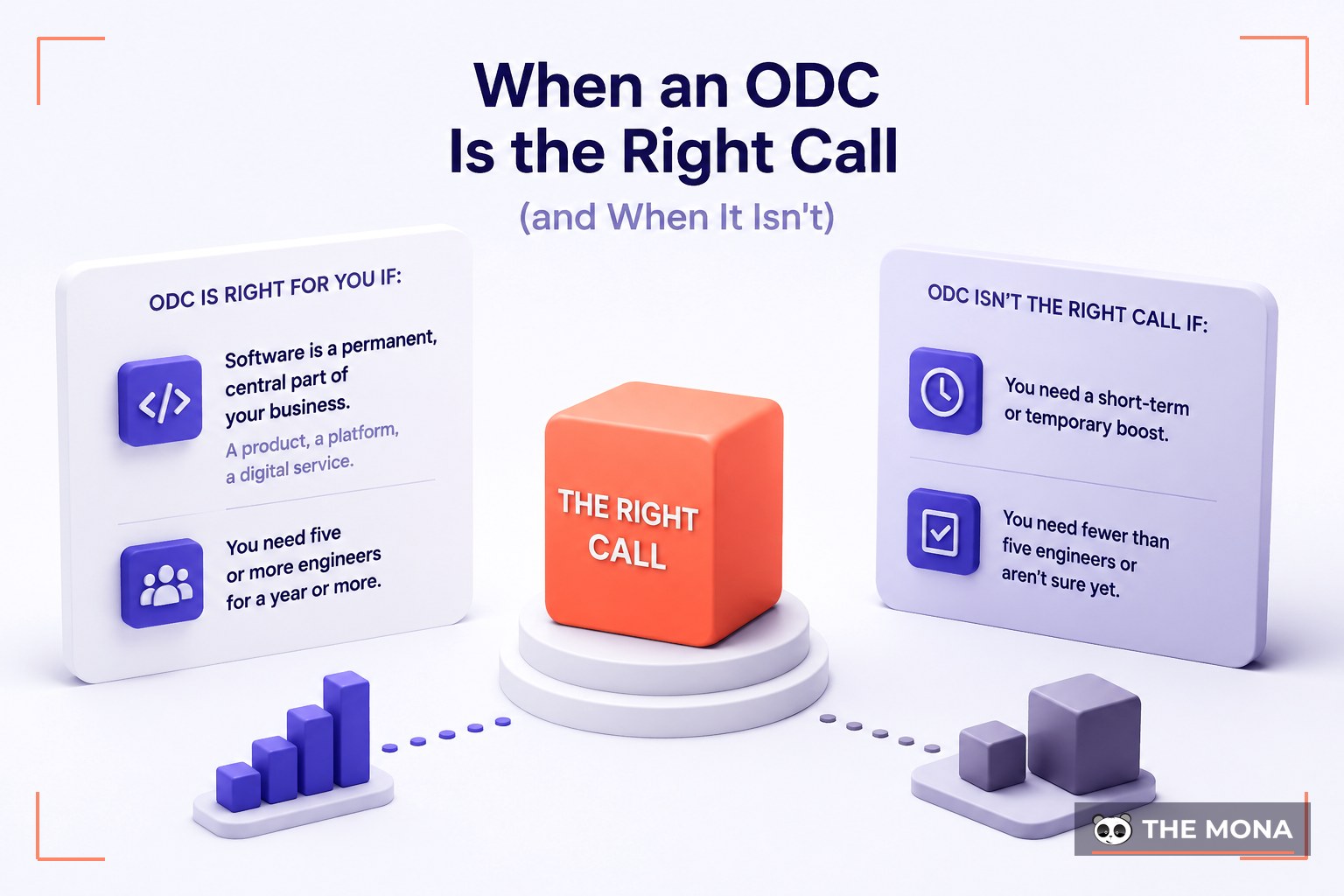
An ODC is right for you if:
- Software is a permanent, central part of your business: a product, a platform, a digital service.
- You need five or more engineers for a year or more.
- Local hiring is too slow, too expensive, or both.
- You want the team's product knowledge to compound over time instead of walking out the door at project end.
- You are prepared to invest in remote management: clear processes, documented decisions, real onboarding.
An ODC is the wrong tool if:
- You have a single bounded project: use offshore software development on a project basis instead.
- You need fewer than five people: staff augmentation is the better fit.
- Nobody on your side can own the relationship. An unmanaged offshore team is just an expensive way to generate misunderstandings.
- You need the team next week and gone next quarter: that is contracting, not an ODC.
Build Your Offshore Development Team with MONA
MONA is a Vietnam-based software development company with more than a decade of delivery experience, an in-house organization spanning engineering, design, and digital, and a track record spanning thousands of businesses, from local enterprises to international clients in demanding markets like Japan, Australia, and Europe.
MONA's 85% client retention rate reflects how those relationships tend to go. Call 1900 636 648 anytime to talk through your ODC before committing to anything in writing.
What that means for your ODC:
- We already have the machine. Offices in Vietnam, in-house recruiters, HR and payroll operations, and senior leads who have run distributed delivery for international clients for years.
- English-first international delivery. Dedicated, English-proficient project managers for every engagement, transparent reporting, and communication practices built for overseas clients across time zones.
- Full-stack capability under one roof. Web platforms, e-commerce, custom software, CRM/ERP systems, mobile, cloud hosting, and AI development, so your ODC can grow into new competencies without a new vendor search.
- Flexible engagement path. Start with a pilot project or a small dedicated team, expand into a managed ODC as trust builds, and, if you want it, transfer the operation in-house later.
- Your IP, unambiguously. Every contract assigns work product to you, with confidentiality and security practices appropriate for clients from strict regulatory environments.
Ready to Scope Your Offshore Development Center?
Tell us the roles you need and the roadmap you are building toward, and we will come back with a concrete team proposal: profiles, timeline, and transparent pricing.