


MONA's IT staff augmentation services place vetted engineers from our in-house team in Vietnam directly into your existing team. They join your standups, use your tools, follow your process, and report to your managers. You stay in full control; we handle sourcing, employment, and retention.
What IT Staff Augmentation Means in Practice
Quick orientation: staff augmentation means you manage the engineers yourself, inside your own workflow. If you'd rather hand us a whole workstream and have MONA manage the team end to end, you're looking for a dedicated development team. Not sure which fits? The comparison further down this page settles it in two minutes.

IT staff augmentation is the simplest of all outsourcing models to understand, because almost nothing about your operation changes. You have a team, a backlog, a process, and a gap: a React developer who resigned, a backend role you've been trying to fill for a quarter, a delivery deadline your current headcount can't reach. Staff augmentation fills that gap with an external engineer who works as if they were your own hire.
The augmented engineer:
- joins your team, not a separate vendor team: same standups, same sprint board, same Slack channels;
- works under your management: your tech lead assigns the tickets, reviews the code, and sets the priorities;
- follows your process and tooling: your Git workflow, your CI/CD, your definition of done;
- scales with your needs: extend, add a second engineer, or roll off when the crunch is over.
What changes is everything you don't have to do: sourcing, screening, employment contracts, payroll, benefits, equipment, retention. MONA employs the engineer; you direct the work. That division of labor is the entire model, and it's why teams that already have strong technical leadership get more from augmentation than from any other engagement type.
If you don't have that internal technical leadership (no one to review code, run sprints, and own architecture), augmentation is the wrong tool, and we'll tell you so on the first call. In that case a dedicated development team with a MONA-side lead, or a fully managed project under our IT outsourcing services, will serve you far better than engineers waiting for direction.
When Staff Augmentation Is the Right Model
Companies come to our staff augmentation services in a handful of recurring situations:
Filling a skills gap without opening a requisition
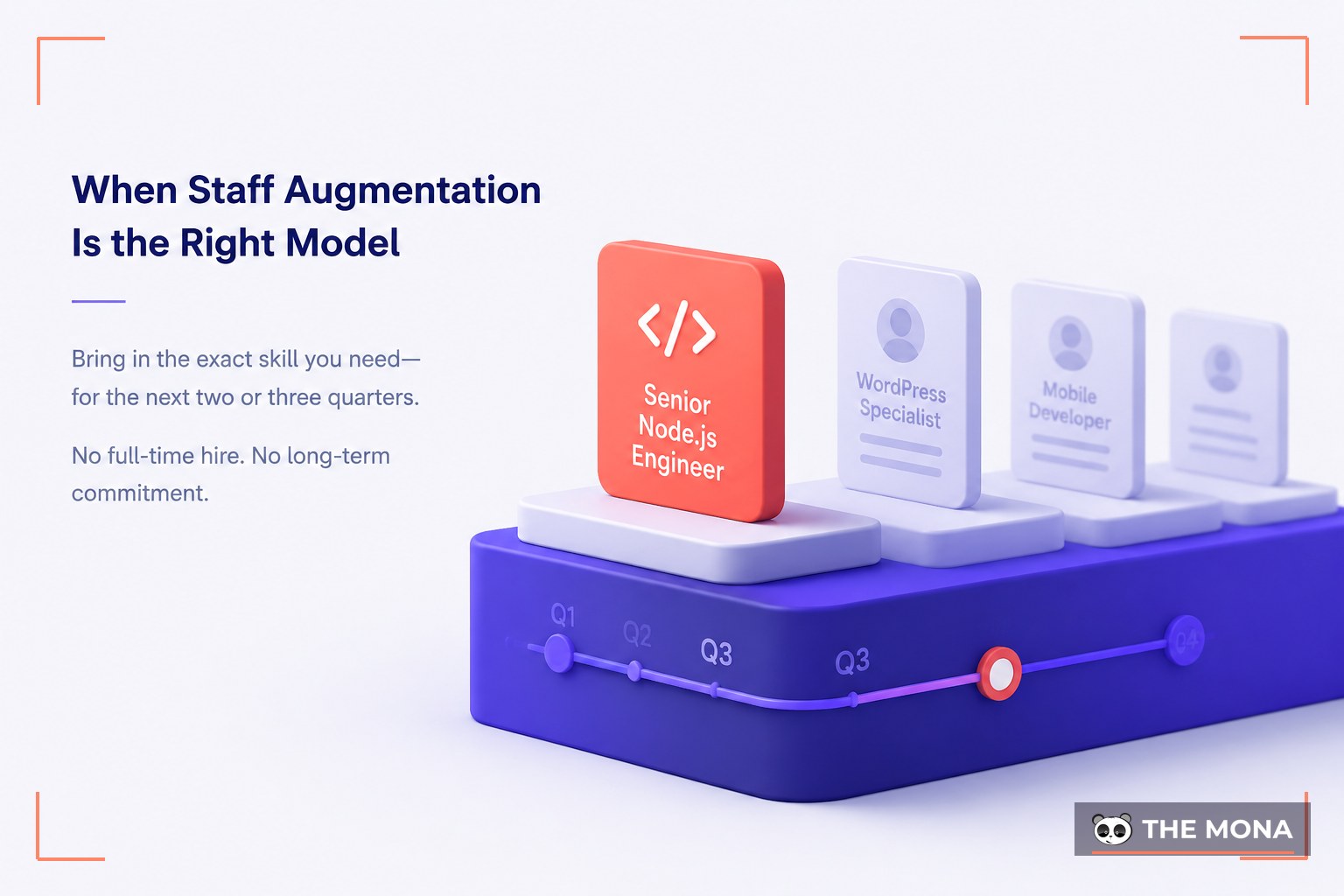
You need a specific competency (a senior Node.js engineer, a WordPress specialist, a mobile developer) for the next two or three quarters, but not necessarily forever. Augmentation gets the skill into the team without the fixed cost and commitment of a permanent hire.
Beating a hiring market you can't win locally
In most Western markets, hiring a senior engineer takes months and the offer competition is brutal. Vietnam's engineering talent pool is one of the deepest in Asia, and MONA has spent 10+ years hiring, training, and retaining the top of it. When your local pipeline is dry, ours isn't.
Accelerating delivery on an existing roadmap
The product direction is set and the team works well; there just isn't enough of it. Adding two or three augmented engineers to an established team is the fastest way to increase throughput, because there's no ramp-up of a new process: your process already exists, and our engineers slot into it.
Bridging attrition and parental or medical leave
A key engineer leaves or steps away, and the backlog doesn't pause. An augmented engineer keeps velocity stable while you run a proper search for the permanent role, or becomes the long-term answer if the collaboration works.
Extending a team you plan to grow offshore
Many clients use team augmentation as the first step toward a larger offshore presence: start with two engineers inside your team, and if the model proves itself, evolve into a full offshore development center with its own structure and scale.
Roles You Can Staff Through MONA
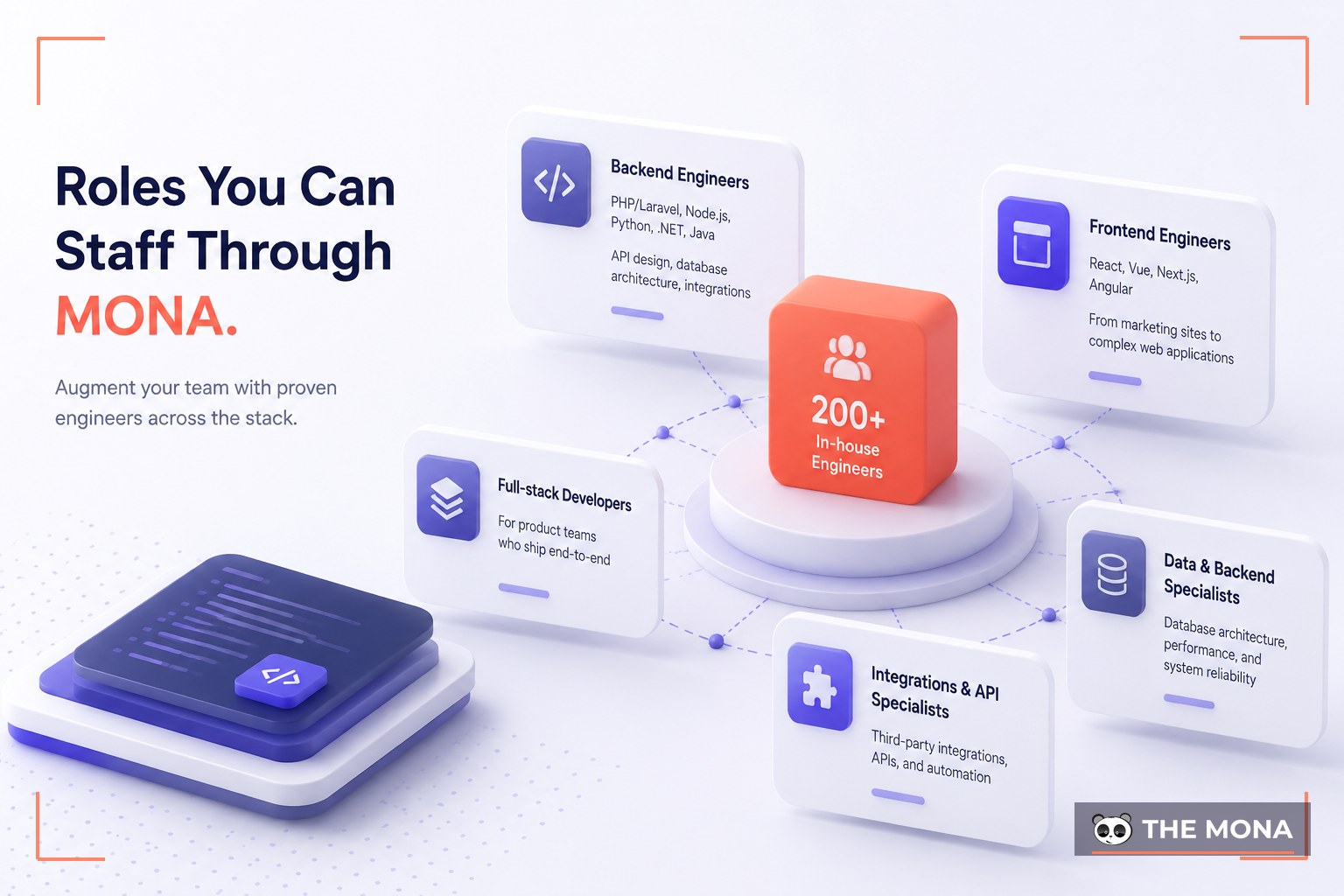
Every augmented engineer comes from MONA's own in-house bench, employed and developed by us, not freelancers relabeled for your project. Typical roles our clients augment:
- Backend engineers: PHP/Laravel, Node.js, Python, .NET, Java; API design, database architecture, integrations
- Frontend engineers: React, Vue, Next.js, Angular; from marketing sites to complex web applications
- Full-stack developers: for teams that need range more than depth in a single layer
- Mobile developers: iOS, Android, Flutter, React Native
- WordPress & e-commerce developers: custom themes, plugins, WooCommerce, Shopify
- QA engineers: manual and automated testing, embedded in your release cycle
- DevOps engineers: CI/CD, cloud infrastructure, monitoring, on our stack or yours
- UI/UX designers: when the gap in your team isn't code
Need to hand-pick individuals rather than describe a role? Our hire developers hub covers hiring by technology and seniority in more detail.
How Our Staff Augmentation Services Work

We've stripped the process to five steps, because speed is half the point of this model:
- Requirements call. You describe the role: stack, seniority, team context, time zone expectations, start date. If augmentation isn't the right model for your situation, we say so here, not after you've signed.
- Profiles within days. We shortlist from our in-house team and present CVs with honest notes: strengths, gaps, English level, past project types. No padded resumes, no bait-and-switch between the CV you approve and the person who shows up.
- You interview and decide. Technical interview, live coding, culture conversation: run whatever process you'd run for your own hires. You reject freely; we shortlist again.
- Onboarding into your team. The engineer joins your repositories, tools, and ceremonies. We handle equipment, security policy compliance, and NDAs on our side. Most engineers are productive inside the first sprint because they're joining your established process, not building a new one.
- Ongoing support and easy scaling. A MONA account manager stays attached to the engagement, not to manage the engineer's work (that's yours), but to resolve anything around it: performance concerns, replacement if a fit isn't working, adding engineers as the roadmap grows, or rolling off cleanly when the need ends.
Throughout the engagement, the management line is deliberately simple: your managers direct the work; MONA guarantees the person. If an engineer isn't performing, we replace them: that risk sits with us, not with you.
Staff Augmentation vs Dedicated Team vs IT Outsourcing

Three models, one honest question: who manages the engineers, and who owns the process?
| Staff Augmentation (this page) | Dedicated Development Team | IT Outsourcing (project-based) | |
|---|---|---|---|
| Who manages day-to-day work | You: your leads, your sprints | MONA: our team lead/PM runs the team for you | MONA: we manage delivery end to end |
| Process & tooling | Yours; our engineers adapt to it | Jointly defined; MONA operates it | MONA's process, with your checkpoints |
| What you buy | Capacity and skills inside your team | A complete, self-managing team on your product | A defined outcome: scope, timeline, deliverable |
| Best when | You have strong technical leadership and an established process | You want a whole workstream or product handled without building the management layer | You want a result, not a team: "build this, launch this" |
| Commitment shape | Per engineer, flexible up/down | Team-level, longer horizon | Per project |
| Typical failure mode elsewhere | Engineers idle without direction (needs your leadership) | Vendor team drifts from business context (needs communication rhythm) | Scope disputes (needs precise specification) |
Rules of thumb we give on calls:
- You have a CTO or tech lead who wants direct control: staff augmentation.
- You have a product roadmap but no bandwidth to manage engineers: a dedicated team.
- You have a defined project and want to hand it over entirely: project-based outsourcing.
Many clients move between models over time: starting with two augmented engineers, converting to a dedicated team once trust is established, and eventually operating a full offshore development center. Because all three models draw on the same in-house organization at MONA, switching is a contract conversation, not a vendor migration.
Why Augment Your Staff from Vietnam, and Why MONA

The Vietnam advantage
Vietnam offers one of the strongest cost-to-quality ratios in global software engineering, with a large, young, technically educated workforce and engineering rates well below US and Western European markets. The GMT+7 time zone overlaps European mornings and US evenings, and our engineers are accustomed to async-first collaboration (written updates, documented decisions, and disciplined pull-request communication), which is exactly what remote augmentation lives on.
The MONA advantage
- In-house engineers, not a body-shop pipeline. The people we place are MONA employees with careers here, which is why they stay on your project instead of vanishing for a better gig mid-sprint.
- 10+ years of delivery, 14,000+ projects delivered across custom software, web development, and cloud infrastructure. Our engineers have shipped real systems, in teams, under deadlines, not just passed screening tests.
- Proven with high-standards international clients, including Japanese businesses where documentation discipline and process precision are non-negotiable.
- English-proficient engineers with an account manager as backstop. Communication issues get fixed, not tolerated.
- Replacement guarantee. If the fit isn't right, we replace the engineer. Your delivery risk is capped by design.
- 85% client retention. Most engagements extend well past the original ask. Prefer to talk it through first? Call 1900 636 648.
How to Vet a Staff Augmentation Company

Whether you shortlist MONA or not, ask every staff augmentation company these questions: the market is full of resume brokers wearing engineering-company branding:
- Are the engineers your employees? If they're subcontracted freelancers, retention, confidentiality, and quality control are all someone else's problem, which means they're yours.
- Will I interview the actual person who joins my team? Bait-and-switch between the interviewed engineer and the delivered one is the model's oldest trick. Insist on it contractually.
- What happens when it doesn't work out? A serious partner has a replacement process and absorbs that cost. A broker renegotiates.
- Can the engagement evolve? If you grow from two engineers to a managed team, can the same partner support it, or will you be migrating vendors in a year?
- Who owns the IP? The answer must be an unqualified you, in writing, from day one. At MONA, everything produced by an augmented engineer (code, documentation, credentials) belongs to you.
Ready to Add Engineers to Your Team?
Tell us the role, stack, and start date you need, and we'll send real profiles from our in-house team within days, no months-long hiring cycle.