


MONA engineers complete SaaS products: multi-tenant architecture, subscription billing, roles and permissions, public APIs, security, and the DevOps to scale them. 10+ years of building software, 14,000+ projects delivered. Whether you're a founder productizing a vision or a company turning internal software into a commercial platform, we build SaaS that survives real customers.
What Separates a SaaS Product From "Software With a Login Page"
One boundary up front: if you're still validating whether your idea has a market, start with our software development for startups page. An MVP is a different build with different rules. This page is for when the answer is yes, and now the product has to hold.
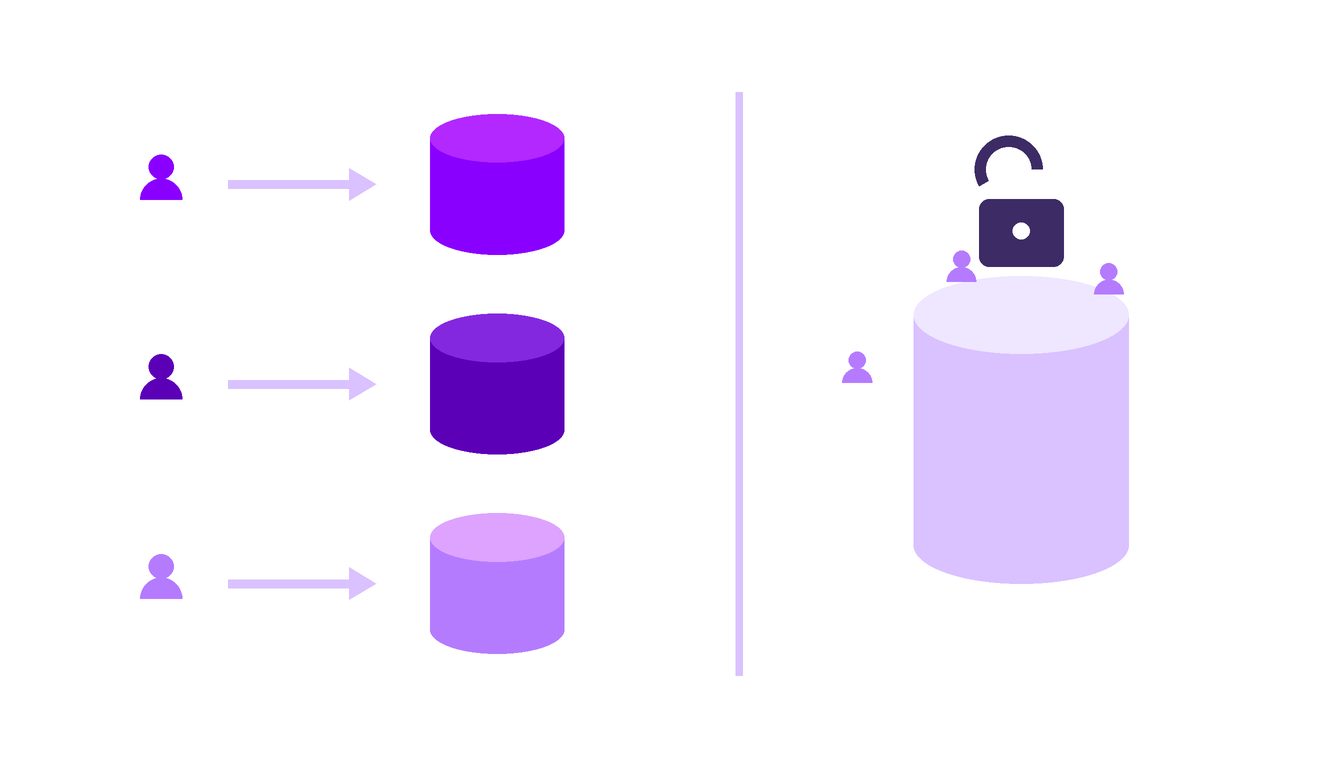
Plenty of vendors will build you an app with accounts and a Stripe button and call it SaaS. Then the second paying customer arrives, and the differences start billing you:
- One customer can see another's data because tenancy was an afterthought, not an architecture.
- Billing edge cases eat your support inbox: proration on mid-cycle upgrades, failed card retries, seat changes, refunds, tax handling across countries.
- Every enterprise prospect asks the same three questions: data isolation, access control, security posture, and every answer costs a custom engineering sprint.
- The demo that flew with 10 users crawls at 1,000, and nobody planned for the database that now needs to be migrated live, under load, with paying customers on it.
A real SaaS product is a business machine: it onboards customers without your involvement, charges them correctly every month, keeps their data provably separate, and scales without a rewrite. That machine has a known set of load-bearing parts, and getting them right the first time is dramatically cheaper than retrofitting them under pressure.
That's what you're actually hiring a SaaS development company for: not screens and endpoints, but the judgment to build those parts correctly before they become emergencies. MONA has spent 10+ years building commercial software, including CRM, ERP, e-commerce, sales and HR platforms, across 14,000+ projects delivered, and SaaS is where all of that converges: product engineering, infrastructure, and billing discipline in one build.
SaaS Development Services We Deliver
Our SaaS development services cover the full lifecycle: architecture, build, launch, and the years after. Engage us for a complete product build or for a specific layer your team is missing.
SaaS Product Architecture & Technical Discovery
Before code, we settle the decisions that are expensive to change later: tenancy model (shared schema, schema-per-tenant, or hybrid, chosen by your data-sensitivity and pricing model, not by fashion), plan structure and how it maps to feature flags, data residency, and the integration surface. You get an architecture document your future CTO will thank you for.
Multi-Tenant Application Development
The core build: a multi-tenant web application where isolation is enforced at every layer: database queries, file storage, caching, background jobs, search indexes. Tenant context is baked into the framework of the codebase so a developer can't accidentally write a cross-tenant query. This is the difference between "we've never leaked data" and "we can show you why we can't." It draws on the same discipline behind our broader web application development practice.
Subscription Billing & Plan Management
We implement the full billing machine: plans, trials, seats, metered usage, proration, dunning (failed-payment recovery), coupons, invoicing, and tax hooks, typically on Stripe, Paddle, or the gateway your markets require. Billing is where SaaS products quietly hemorrhage revenue and trust; we treat it as core product, not an integration checkbox.
Roles, Permissions & Team Accounts
B2B SaaS lives or dies on organizational structure: workspaces, team invitations, role-based access control, admin consoles, audit logs, SSO when enterprise deals demand it. We've built permission systems for a decade's worth of CRMs and ERPs, so we know where the edge cases hide (the departing admin, the agency managing five client workspaces, the auditor who needs read-everything).
Public API & Integration Layer
A documented public API turns your product from a tool into a platform, and it's increasingly the first thing serious customers evaluate. We design versioned REST/GraphQL APIs with authentication, rate limiting, webhooks, and developer documentation, so integrations and partner ecosystems become growth channels instead of support tickets.
AI Features Inside Your SaaS
The 2026 baseline is shifting: customers expect intelligence in the product: AI-assisted content, smart search, document extraction, in-app copilots, usage insights. We build these as maintainable product features with cost controls, evaluation, and graceful fallbacks, not fragile API demos. When AI is the product rather than a feature of it, our AI development company team takes the lead.
DevOps, Scaling & SaaS Operations
Zero-downtime deployments, infrastructure as code, monitoring and alerting, database scaling strategy, backup and disaster recovery, and uptime you can put in an SLA. Your customers don't care that Tuesday's release was hard; we build the pipeline so releases are boring.
Turning Internal Software Into a Commercial SaaS Product
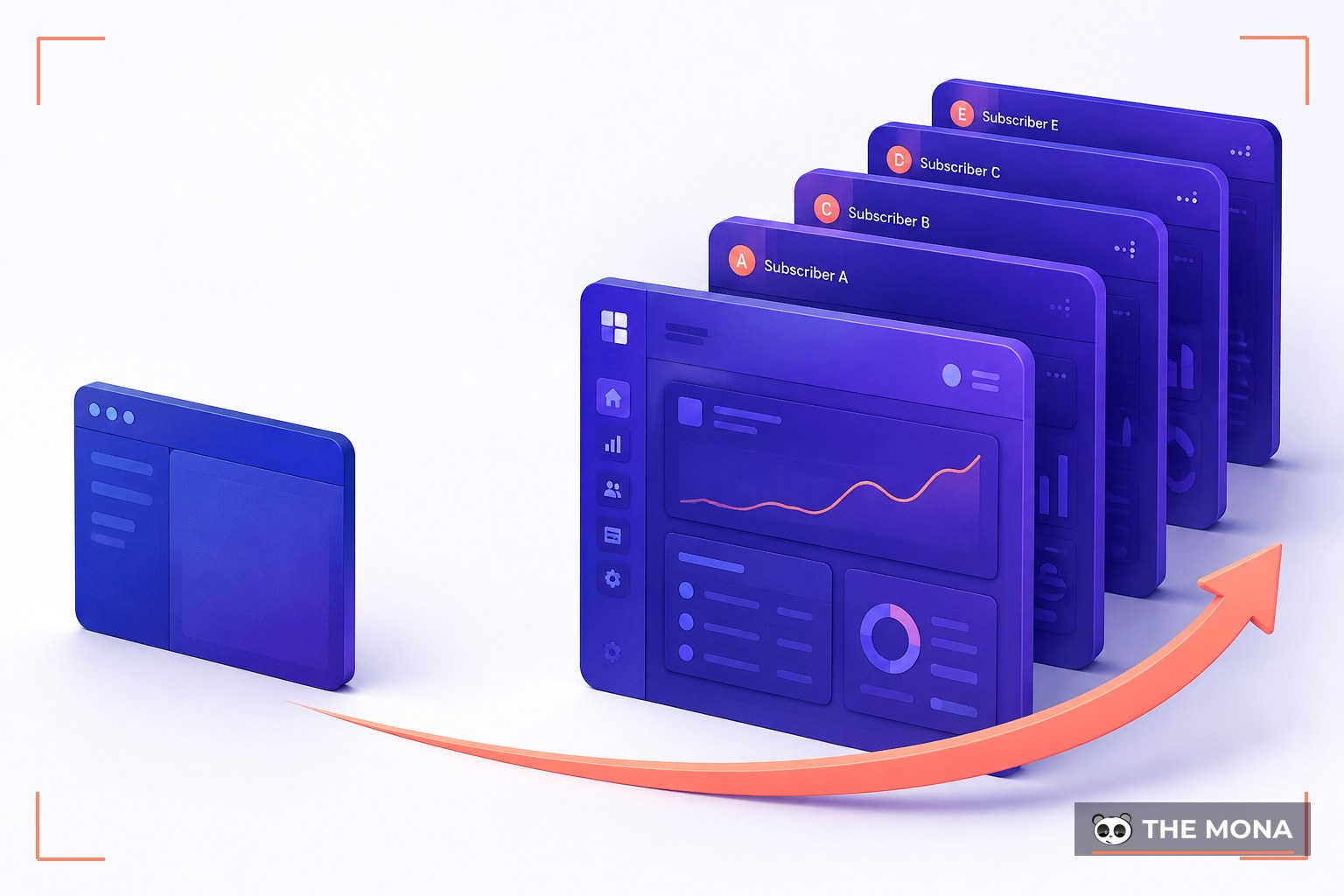
A path we know well, because so many of the 14,000+ projects we've delivered arrive here this way: you built (or commissioned) software that runs your own operations brilliantly, other companies keep asking to use it, and you suspect there's a product in there. There usually is, but the road from internal tool to commercial SaaS is longer than founders expect, and it's mostly invisible work:
- Single-company assumptions are everywhere. Hard-coded workflows, your org chart baked into permissions, "we'll just fix it in the database" habits. We audit the codebase and separate what's product from what's your company leaking into the code.
- Tenancy has to be retrofitted or rebuilt. Sometimes the existing core can be carefully generalized; sometimes the honest answer is a rebuild that reuses the domain logic (the genuinely valuable part) on a new multi-tenant foundation. We tell you which, with reasons, before you spend.
- Internal tolerance is not customer tolerance. Your team forgives clunky onboarding and Thursday downtime. Paying strangers don't. Self-serve signup, billing, documentation, and support tooling are new construction, not polish.
The upside: you're starting with the rarest asset in SaaS: proven workflows validated by years of real operation. Our job is to wrap them in the productized shell that lets outsiders buy, onboard, and pay without your team in the loop.
How a SaaS Build Runs at MONA
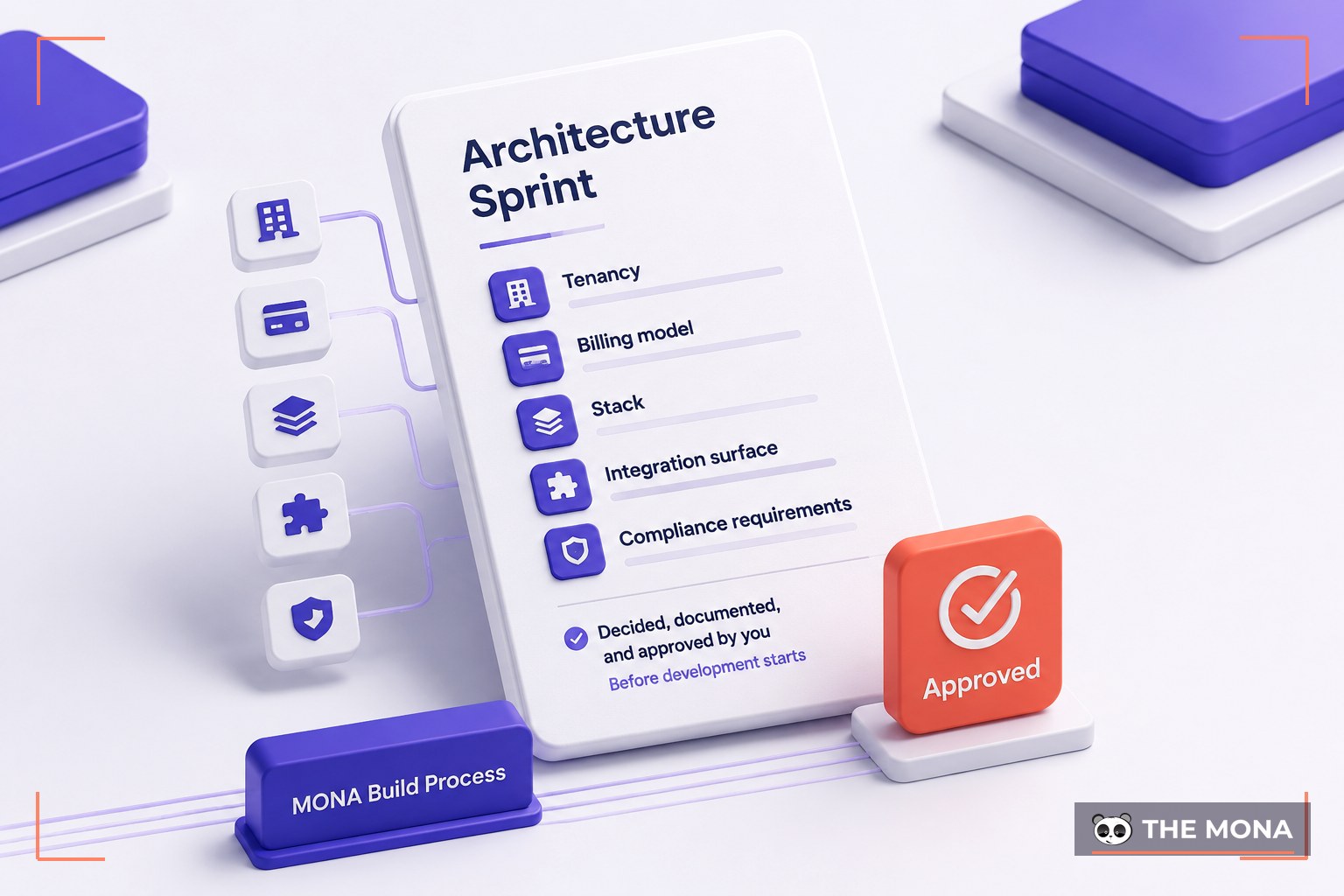
- Architecture Sprint. Tenancy, billing model, stack, integration surface, compliance requirements: decided, documented, and approved by you before development starts.
- Foundation Phase. The load-bearing skeleton first: tenant isolation, authentication, roles, billing plumbing, CI/CD. This is deliberately front-loaded: it's the part that's brutal to change later.
- Product Build in Weekly Increments. Features ship to a staging environment every week. You steer with working software in hand, not status decks.
- Hardening & Compliance Pass. Security review against OWASP risks, penetration-test remediation, data encryption in transit and at rest, backup and recovery drills, GDPR-aligned data handling (export, deletion, consent): the baseline your enterprise prospects' security questionnaires will probe.
- Launch & Early Operations. Production deployment, monitoring dashboards, error alerting, on-call arrangements. We watch the first real cohorts with you and tune what the data exposes.
- Grow & Extend. New plans, new modules, the public API, AI features, performance work as usage climbs. Most clients keep the team on as a dedicated development team. SaaS is never finished, and the team that built it iterates fastest.
Throughout: a dedicated project manager, English-language communication, and full ownership of everything, including source code, infrastructure, documentation, credentials. Your product is never held hostage by your vendor.
Why Product Companies Choose MONA as Their SaaS Development Company
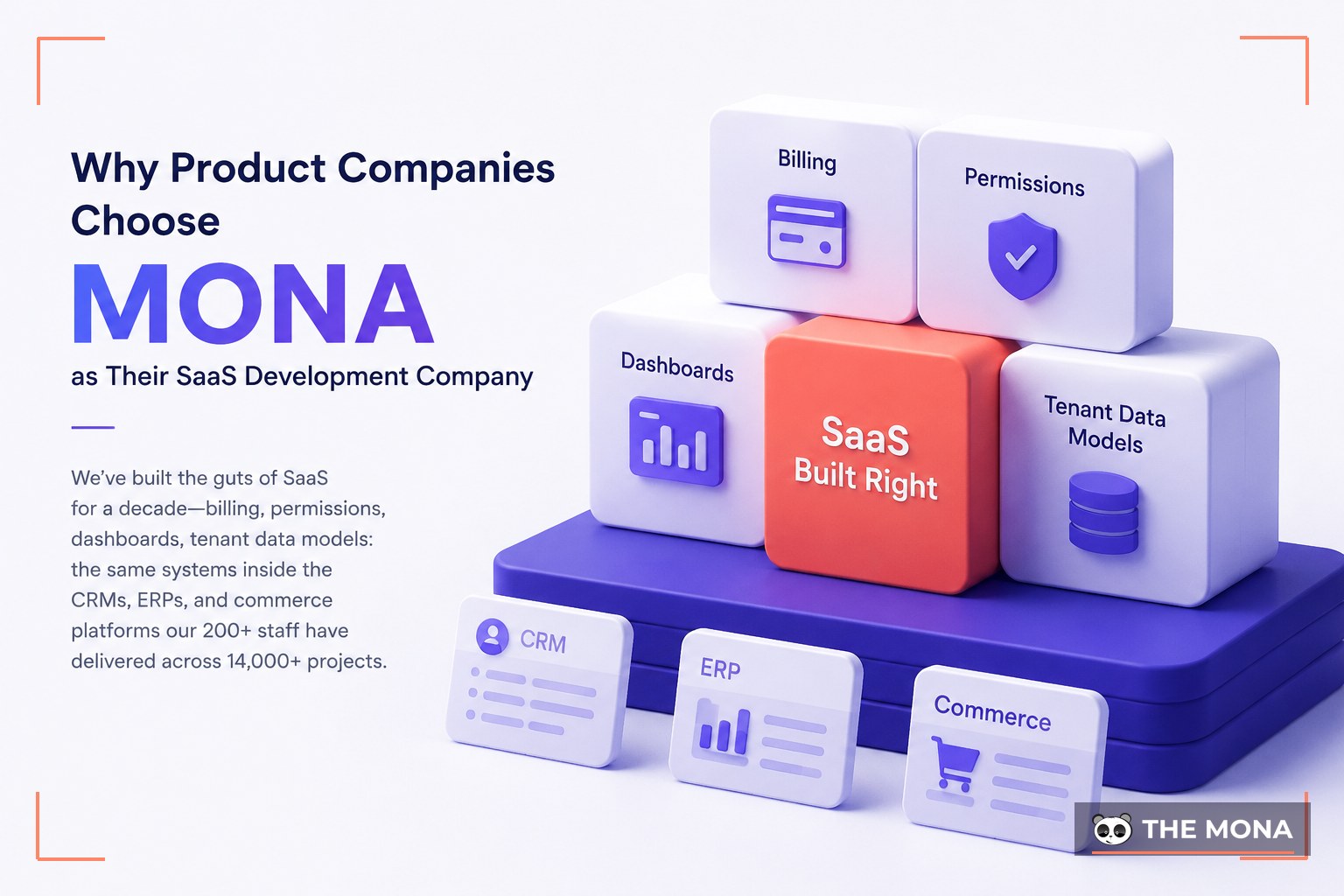
- We've built the guts of SaaS for a decade. Billing, permissions, dashboards, tenant data models: these are the same systems inside the CRMs, ERPs, and commerce platforms our in-house team has delivered across 14,000+ projects. You're not funding our learning curve.
- In-house team, long-horizon engagements. All engineers are full-time MONA employees in Vietnam. SaaS products need the same people across years, and an in-house structure is what makes that continuity real: no broker-network roulette.
- Vietnam economics change what you can afford to build. At Vietnam engineering rates, the budget that buys a thin v1 from a Western agency buys you the durable version here: proper isolation, proper billing, proper ops. In SaaS, that difference compounds monthly.
- One partner across the whole surface. Product engineering, infrastructure, integrations, AI features: under one roof with a full software development company behind it, instead of a vendor zoo with seams between every layer.
- Time zone that works. GMT+7 overlaps European mornings and US evenings; you talk to your team every working day.
And the same honesty we open with: if your scope describes an experiment, we'll say so and point you to the leaner MVP path. Selling you a full SaaS build you don't need yet is bad engineering.
Tech Stack for SaaS Builds
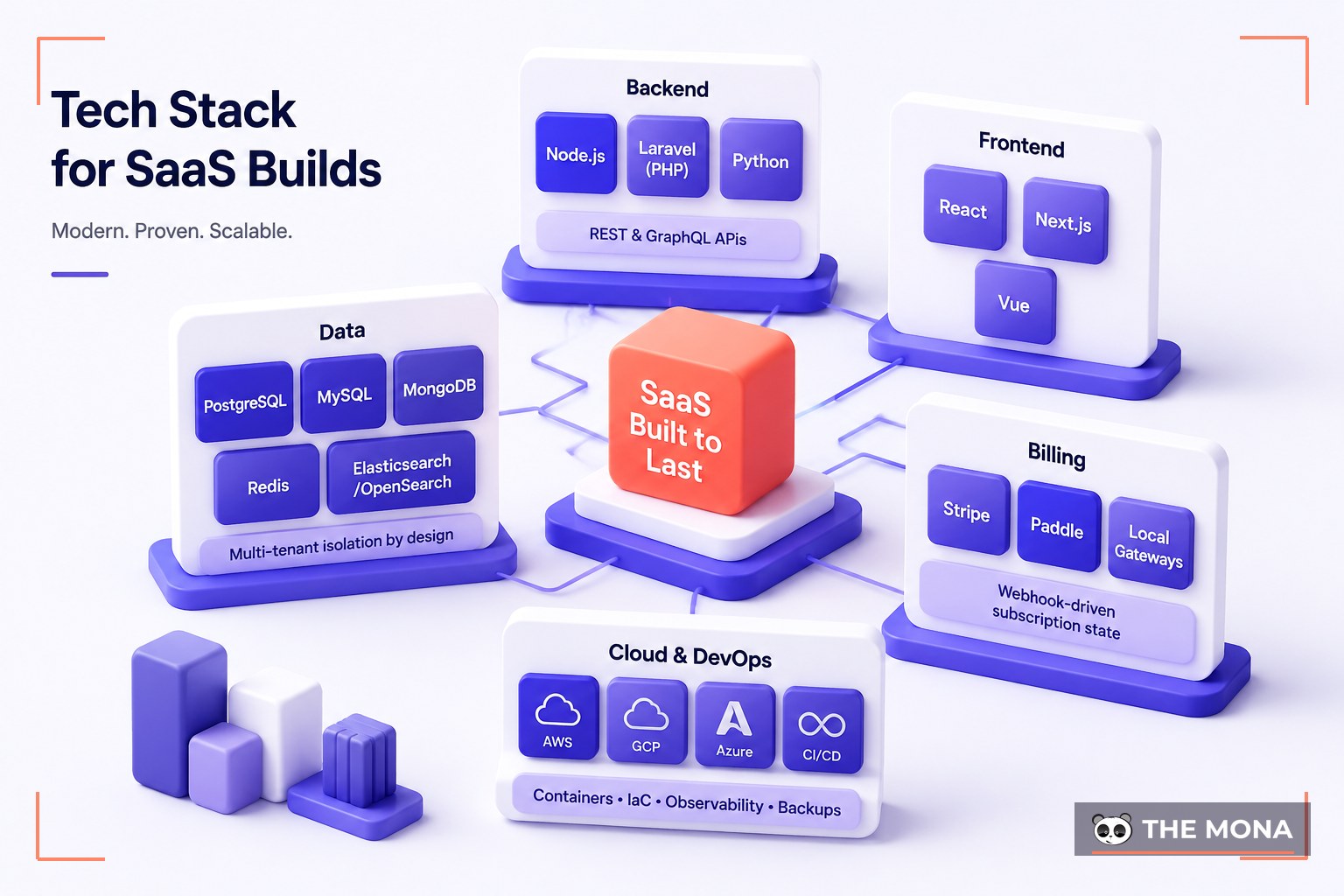
Chosen for longevity: hireable skills, proven scaling stories, no exotic lock-in:
- Backend: Node.js, PHP (Laravel), Python; REST & GraphQL APIs
- Frontend: React, Next.js, Vue
- Data: PostgreSQL (our default for multi-tenant isolation), MySQL, MongoDB, Redis; search via Elasticsearch/OpenSearch
- Billing: Stripe, Paddle, or region-specific gateways; webhook-driven subscription state
- Cloud & DevOps: AWS/GCP/Azure or our own cloud hosting infrastructure; Docker, Kubernetes where scale warrants it, infrastructure as code, CI/CD with zero-downtime deploys
- AI layer: LLM integrations (OpenAI, Anthropic, Gemini) and self-hosted open-source models where data privacy requires it
Ready to Build the SaaS Product That Lasts?
Tell us where you are, productizing an idea or turning internal software into a platform, and we'll map the architecture decisions that matter before you write a line of code.