


MONA is an ERP development company with 14,000+ projects delivered since 2016. We build custom ERP software around your real finance, inventory, procurement, and production workflows, connect it to the systems you already run, and hand you the code. No per-user license fees, no forcing your operations into someone else's structure.
Why ERP Projects Stall When Off-the-Shelf Software Doesn't Fit Your Operations
In short: an ERP development company designs and builds enterprise resource planning software that unifies finance, inventory, procurement, manufacturing, and reporting into a single system built around how a business actually operates, not a generic template. MONA builds custom ERP software with full code ownership, no per-user licensing, and modules shaped to the workflow already in place, including POS and retail/F&B management.
Most companies that come looking for a custom ERP have already lived through the frustration of a licensed platform that almost fits. The finance team runs the general ledger in one system. Inventory lives in a spreadsheet someone updates by hand. Procurement approvals move through email and chat, with no record tied back to a purchase order. Production scheduling sits on a whiteboard two people are editing at once.
None of this is a management failure. It's what happens when a business grows past the point a generic system, or a pile of disconnected tools, can track.
The cost shows up in three places: reconciliation hours, as finance closes the month by manually matching numbers across systems that should already agree; stock blind spots, where businesses without real-time inventory either overstock to be safe or run out and lose the sale; and decisions made on stale data, as reports get assembled by hand from exports that are already a week old by the time leadership sees them.
The licensing math compounds the problem. A packaged ERP like SAP or Odoo prices by user, by module, and often by the consultants needed to configure it. That bill looks manageable with ten users. Multiply it by every hire, branch, and module a growing operation needs, and the platform meant to save money becomes one of the largest recurring line items on the books.
An ERP development company that builds custom software solves the structural problem, not just the symptom: one system, shaped to the actual process, owned outright instead of rented indefinitely.
Custom ERP Development vs SAP and Odoo: The Honest Math
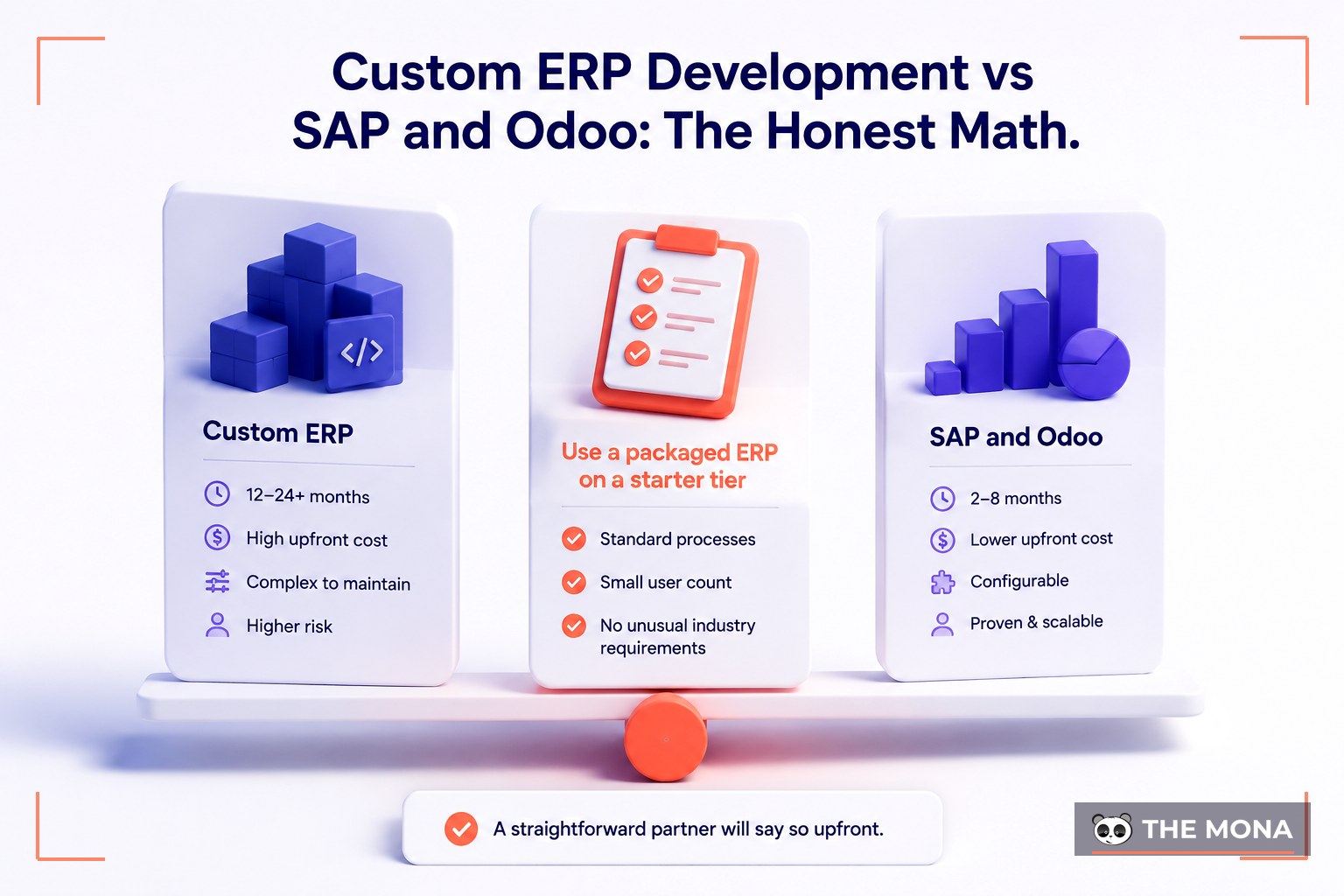
Not every business should build a custom ERP. If a company runs a standard process, a small user count, and no unusual industry requirements, a packaged platform on a starter tier is often the faster, cheaper way to start, and a straightforward partner should say so upfront.
Custom ERP development tends to win when one or more of these is true:
- The license-plus-consultant bill keeps climbing. Packaged ERPs charge for the platform and separately for the consultants who configure it, and both costs scale with headcount and module count.
- The business runs an industry the platform wasn't built for. Retail chains, F&B groups, jewelry and import/export operations, and multi-branch distributors often need logic a generic ERP treats as costly customization rather than a native feature.
- Departments still keep parallel spreadsheets. If finance, inventory, and procurement each maintain a workaround next to the "system of record," that's the clearest sign the platform doesn't match the operation.
- Integration runs deep, and ownership matters. A custom ERP connects directly with POS terminals, e-commerce, and supplier systems on a schedule the business controls, and the business owns the source code and data outright.
The trade-off runs the other way too: a custom build takes longer to launch than activating a SaaS account, and it depends on choosing a partner that understands operations, not just code. The rest of this page makes the case for MONA as that partner.
ERP vs CRM: Two Different Systems, Often Confused
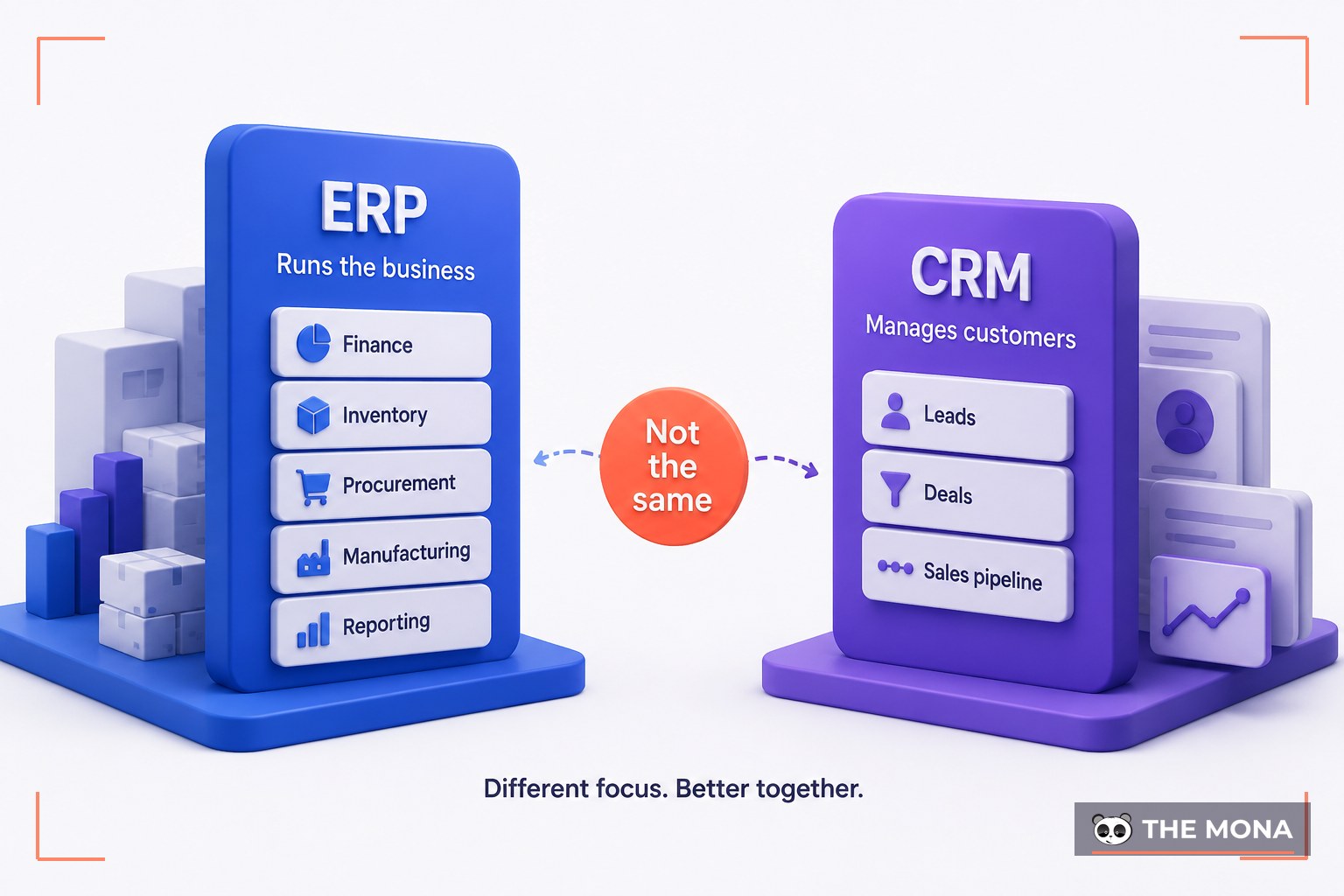
An ERP manages what happens inside the business: finance, inventory, procurement, manufacturing, and the reporting tying them together. A CRM manages what happens with customers: leads, deals, and the sales pipeline. Many growing businesses need both, integrated so a closed deal in the CRM flows into an order in the ERP without anyone re-typing it.
For a closer comparison, see ERP vs CRM: What Each One Actually Does. If the sales side is the priority, MONA's CRM development company page covers that build in full.
ERP Development Services We Deliver
Our ERP development services cover the full lifecycle: process mapping, module design, build, integration, migration, and long-term support, starting from how the departments actually work, not a fixed feature catalogue.
Custom ERP Development from Scratch
An ERP designed around a business's own chart of accounts, warehouse structure, approval chains, and production steps, built as a web-based system with role-based access so each department sees only what it needs. As a full-scale software development company, we build ERPs on the same discipline as any production system: version control, staging environments, documented handover.
Core ERP Modules: Finance, Inventory, Procurement, and Manufacturing
Every build draws from the same core set of modules, scoped to what the business actually needs:
- Finance & accounting: general ledger, accounts payable and receivable, budgeting, multi-branch consolidation
- Inventory & warehouse management: real-time stock levels, multi-location transfers, batch and expiry tracking, low-stock alerts
- Procurement & purchasing: purchase requisitions, supplier records, approval workflows, purchase-order matching against goods received
- Manufacturing & production: bill of materials, production scheduling, work-order tracking, raw-material consumption
- HR & payroll: staff records, attendance, payroll calculation, tied to cost centers in finance
- Reporting & dashboards: the reports management actually asks for, pulled live from every module instead of assembled by hand
POS & Retail / F&B Management Systems
This is where the ERP connects to a product line MONA already operates through mona.software: point-of-sale and back-office systems for retail and F&B businesses. Fashion, electronics, cosmetics, auto parts, and jewelry retailers, along with restaurants, cafes, and bars, run day-to-day sales on POS software that syncs directly into the same finance and inventory modules powering the rest of the ERP.
For a business with physical locations, that means one register at the counter and one source of truth behind it: a sale at any branch updates stock, revenue, and cost of goods in real time, with consolidated reporting across every location instead of a spreadsheet stitched together at month-end.
System Integration & Legacy Data Migration
An ERP that doesn't talk to the rest of the business becomes another disconnected system. We integrate ERP modules with e-commerce, accounting software, CRM, payment gateways, and supplier or logistics systems, through standard APIs where they exist and custom connectors where they don't. For businesses that also want the manual steps around the ERP automated, such as approval routing, see our business process automation services. Migrating off an existing platform, or off spreadsheets, runs through field mapping, deduplication, and validation before cutover.
Ongoing Support & Evolution
An ERP keeps changing because the business keeps changing: new branches, product lines, regulations. After launch we provide monitoring, maintenance, and iterative development under a support agreement, without forced upgrade cycles.
Our ERP Development Process
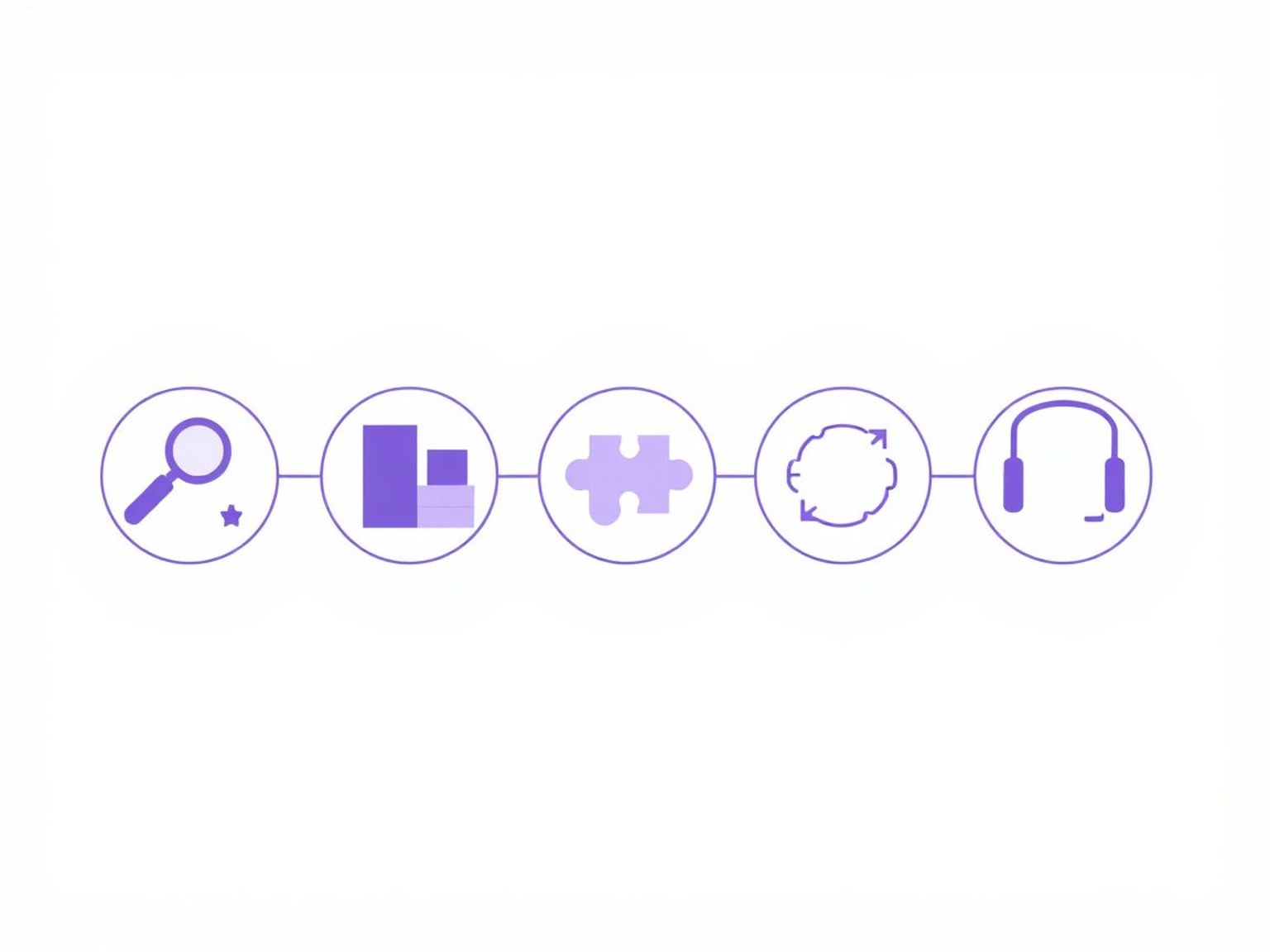
- Discovery & process mapping. We sit with the people running finance, warehouse, procurement, and production, and document how work actually flows between them. Output: a process map and a scoped module list, ranked by priority.
- Data model & module design. We design the chart of accounts, inventory structure, and workflow logic for each module, reviewed with the team before development starts.
- Build in phases. Modules are developed and demoed as working software in stages, so course corrections happen in weeks, not at final delivery.
- Integration & migration. We connect existing POS, accounting, e-commerce, and supplier systems, and migrate historical data with validation passes before cutover.
- Pilot by department or branch. One department or location goes live first. We tune based on real usage before rolling out company-wide.
- Rollout, training & support. Full deployment with documentation and training, followed by monitoring and a roadmap of improvements as the business grows.
Why MONA as Your ERP Development Company
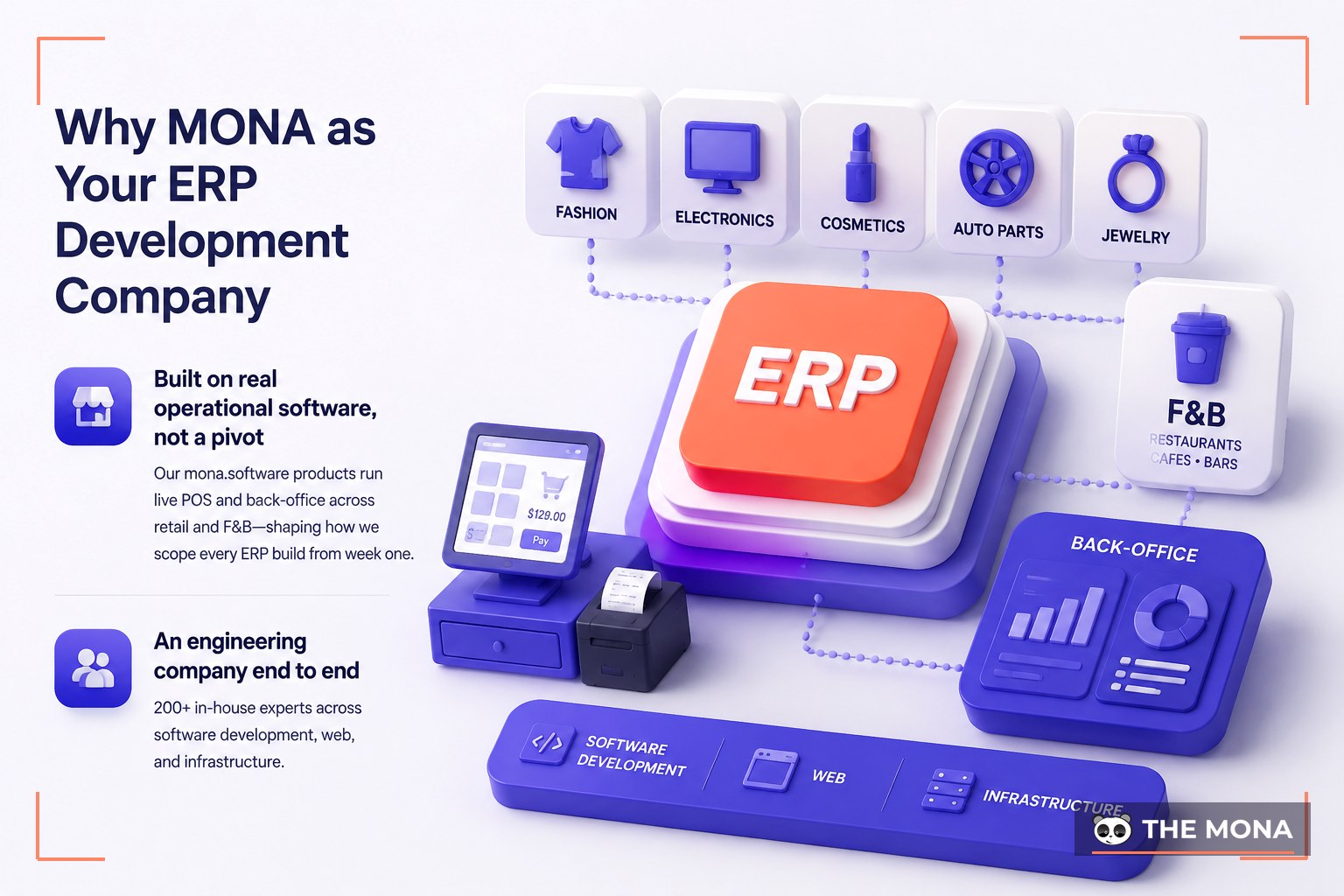
Built on real operational software, not a pivot
MONA's mona.software product line runs live point-of-sale and back-office systems for retail categories including fashion, electronics, cosmetics, auto parts, and jewelry, plus F&B from restaurants to cafes and bars, shaping how we scope every ERP build from week one.
An engineering company end to end
An in-house team across software development, web, and infrastructure, spanning custom software, digital solutions, and cloud hosting. An ERP can run on infrastructure MONA manages or a business's own cloud, with one accountable team from database to browser.
Vietnam economics, international standards
Building custom software with Vietnam-based engineering costs a fraction of US or Western European rates, making a full custom ERP viable at mid-market budgets that used to require enterprise pricing. The team works in English with dedicated project managers, in a GMT+7 time zone overlapping European mornings and US evenings, and has delivered for demanding clients including Japanese businesses, where precision is non-negotiable.
You own everything
Source code, database, and documentation belong to the business, in the contract. No per-user licenses, no module unlocked only at a higher tier, no vendor able to raise prices on software already in production. Across MONA's 14,000+ projects since 2016, client retention runs at 85%.
Technology Stack
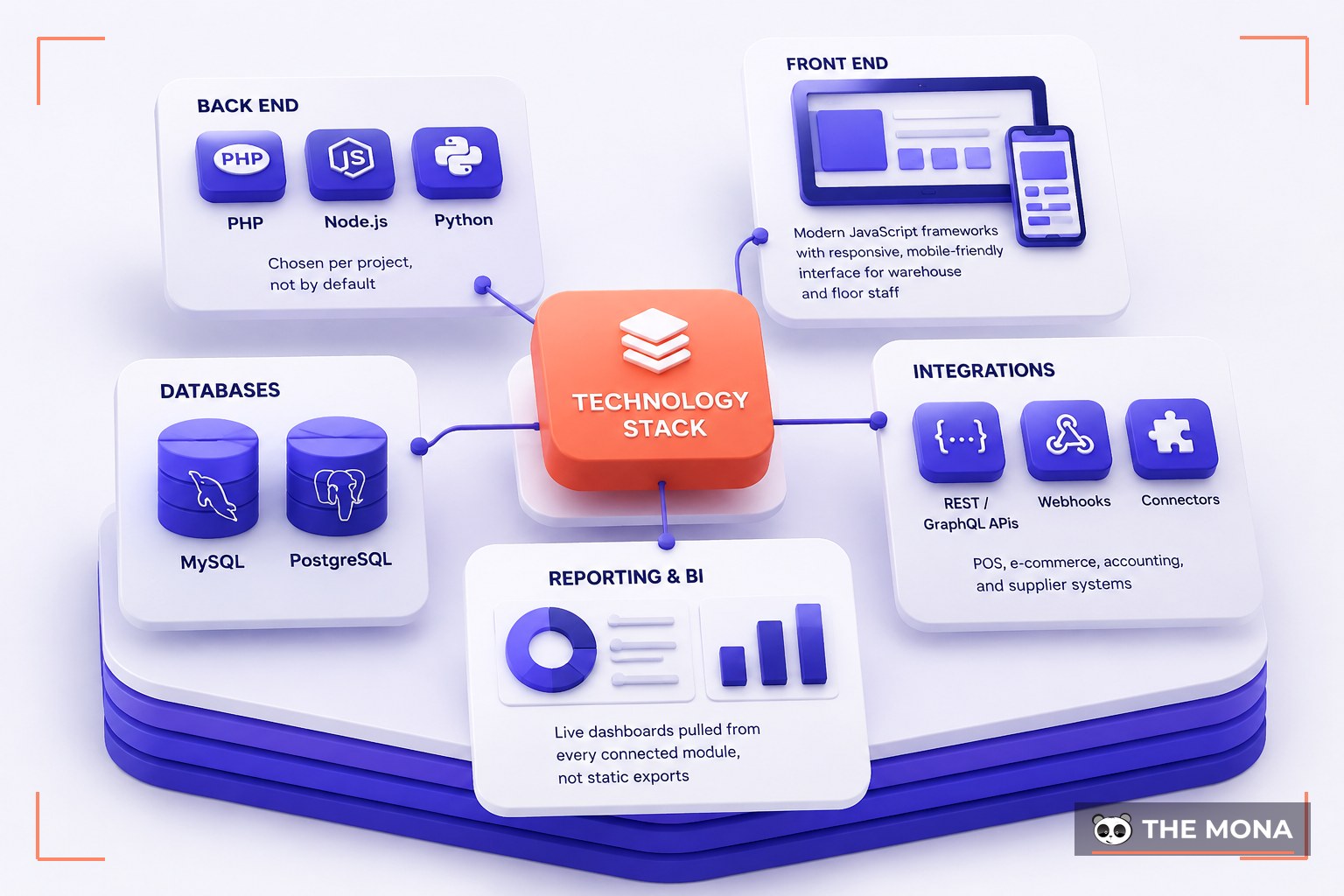
- Back end: PHP, Node.js, Python, chosen per project rather than by default
- Front end: modern JavaScript frameworks with a responsive, mobile-friendly interface for warehouse and floor staff
- Databases: MySQL, PostgreSQL
- Integrations: REST/GraphQL APIs, webhooks, connectors for POS, e-commerce, accounting, and supplier systems
- Reporting & BI: live dashboards pulled from every connected module, not static exports
- Hosting: MONA's own cloud and VPS infrastructure, or a business's existing AWS/GCP/Azure environment
Engagement Models
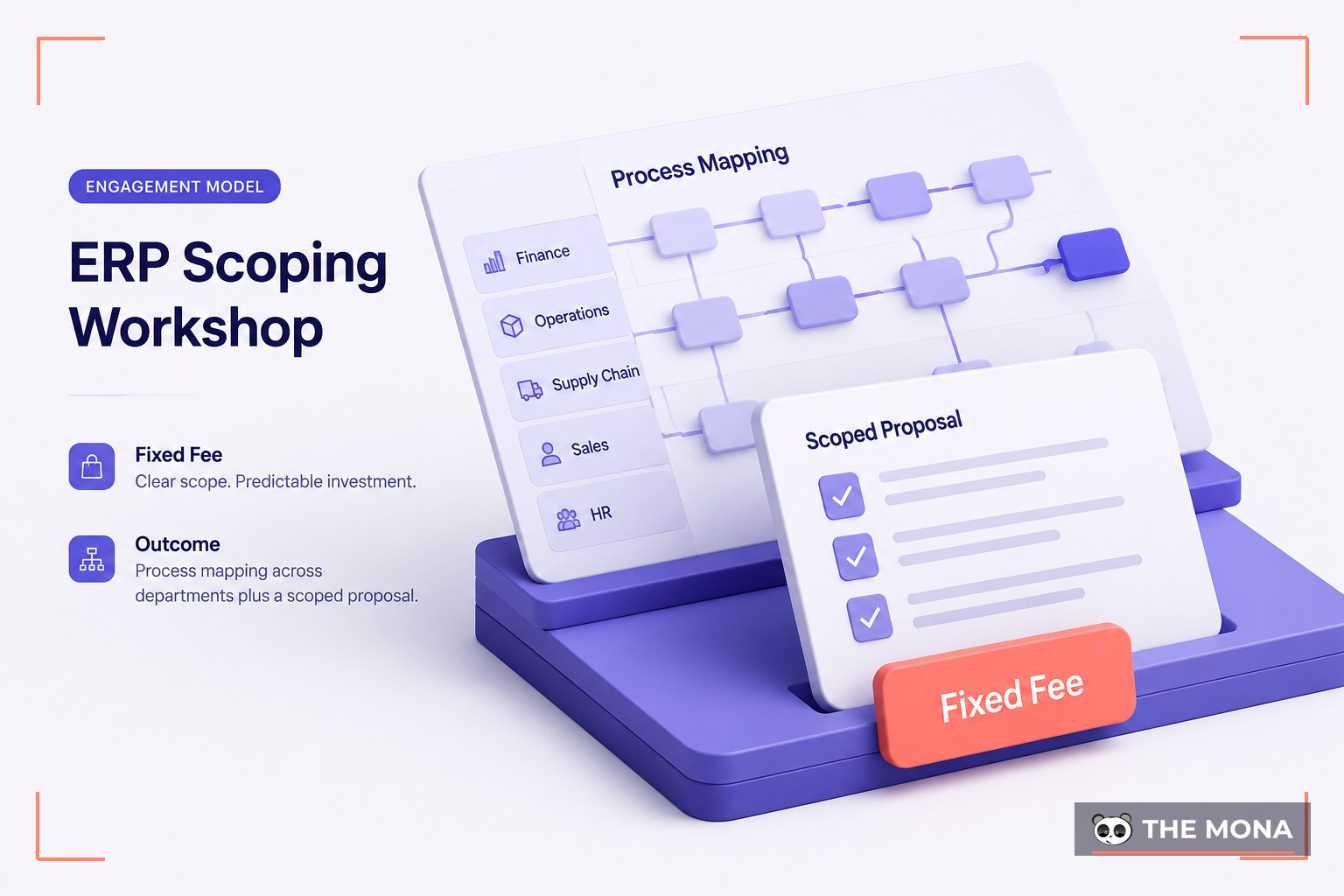
- ERP Scoping Workshop (fixed fee). Process mapping across departments plus a scoped proposal. If a packaged platform is the honest answer for a business's size, the report says so.
- Fixed-Scope Build. A defined set of modules, price, and timeline. Best when the workflow is already well understood.
- Build & Evolve Retainer. Launch core finance and inventory modules first, then extend monthly as usage reveals what's needed next.
- Dedicated ERP Team. For larger builds spanning multiple modules and branches, a dedicated development team works exclusively on the system.
Every model starts with a free consultation. Call 1900 636 648 or book a session to get a straight answer on whether a custom ERP fits before committing to anything.
Ready to Build an ERP That Fits How You Work?
Tell us what's stuck in spreadsheets, email threads, or a whiteboard right now, and we'll show you what a custom ERP would replace it with, honestly, before you commit to anything.